
The research is consistent on one point: most couples wait an average of six years after problems begin before seeking professional help. That finding, documented across multiple studies of couples therapy outcomes, means that by the time many couples walk into a psychologist’s office, years of resentment, disconnection, and entrenched patterns have accumulated — making treatment harder and longer than it needed to be.
In Venice, FL, finding the right provider for couples work matters more than most people realize. The credentials, training, and approach of the person guiding your relationship through a difficult period can make the difference between genuine repair and a frustrating experience that confirms the belief that “therapy doesn’t work.”
This article covers when couples therapy is likely to help, what evidence-based treatment actually involves, and what to expect if you’re considering working with a psychologist at our Venice office.
Signs It’s Time for Couples Therapy
Not every disagreement requires professional intervention. Healthy relationships include conflict — it’s how the conflict is managed that determines outcomes. However, certain patterns indicate that the relationship has moved beyond what the couple can resolve on their own.
Communication has broken down. Conversations that used to be productive now escalate into arguments or shut down entirely. You’re talking at each other rather than with each other, or you’ve stopped talking about anything meaningful at all.
The same arguments repeat without resolution. You’ve had the same fight dozens of times and nothing changes. This pattern — what researchers call “gridlocked conflict” — indicates that underlying needs or values are in tension and require structured exploration to understand.
Emotional distance has replaced connection. You’re functioning as roommates rather than partners. The warmth, affection, and sense of being a team have faded. One or both of you feels lonely in the relationship.
Contempt has entered the dynamic. Eye-rolling, sarcasm, name-calling, and dismissiveness represent contempt — which research by Gottman and colleagues has identified as the single strongest predictor of divorce. When one or both partners regularly express contempt, the relationship is in serious trouble.
There’s been a trust breach. Infidelity, financial deception, or other betrayals create wounds that rarely heal without professional support. The injured partner needs a structured process for addressing the breach, and the offending partner needs guidance on genuine accountability and repair.
A life transition is creating stress. Retirement and relocation to Venice, health changes, caregiving responsibilities, blending families, or adult children returning home — these transitions test relationships in ways that may exceed the couple’s existing coping resources.
What Evidence-Based Couples Therapy Looks Like
Not all couples therapy is created equal. The approach matters, and the research clearly identifies which approaches produce the best outcomes.
Gottman Method Couples Therapy is grounded in over four decades of research at the Gottman Institute, including longitudinal studies of thousands of couples. The approach focuses on building friendship, managing conflict constructively, and creating shared meaning. Gottman’s research identified specific behaviors that predict relationship success and failure — providing a research-based framework for understanding what’s going wrong and what needs to change.
Emotionally Focused Therapy (EFT), developed by Sue Johnson, is an attachment-based approach that focuses on the emotional bonds between partners. EFT views relationship distress as rooted in unmet attachment needs — the need to feel safe, connected, and valued by your partner. By identifying the negative interaction cycles that prevent these needs from being met, EFT helps couples create more secure emotional bonds. Research consistently demonstrates EFT’s effectiveness, with approximately 70–75% of couples moving from distress to recovery.
A key advantage of working with a doctoral-level psychologist for couples work is the assessment-first approach. Individual mental health conditions — depression, anxiety, ADHD, trauma histories, personality factors — frequently masquerade as relationship problems. A psychologist trained in both individual and couples assessment can identify when what appears to be a communication problem is actually being driven by an undiagnosed condition in one or both partners. This distinction is critical because treating the relationship without addressing the individual condition produces limited and often temporary results.
For more information about our approach, visit our couples counseling services page.
The research on couples therapy outcomes has improved substantially in the last two decades. A meta-analysis by Lebow and colleagues (2012) found that evidence-based couples therapy produces significant improvement in relationship satisfaction for approximately two-thirds of couples, with the strongest effects observed when therapy begins before patterns become deeply entrenched. This finding reinforces the importance of seeking help earlier rather than later — the six-year average delay documented in the literature represents years of accumulated damage that makes treatment longer and more difficult.
It’s worth noting that couples therapy is not the same as individual therapy conducted with two people in the room. The relationship itself is the patient. A psychologist trained in couples work maintains neutrality between partners, tracks interaction patterns in real time, and interventions target the dynamic between partners rather than the individual psychology of either one.
Psychologist vs. Other Providers for Couples Work
In Florida, several types of providers offer couples therapy — including licensed mental health counselors (LMHCs), licensed clinical social workers (LCSWs), and licensed marriage and family therapists (LMFTs). What distinguishes a doctoral-level psychologist in this context?
Assessment depth. Psychologists with Psy.D. or Ph.D. degrees complete extensive training in psychological assessment. When individual pathology is affecting a relationship — and it frequently is — a psychologist can identify it through formal evaluation rather than relying solely on clinical impression. This matters because ADHD, mood disorders, trauma, and personality features all affect relationships in specific ways that require different treatment strategies.
Research training. Doctoral programs require training in research methodology, which means psychologists can evaluate the evidence base for different approaches and select treatments that have demonstrated effectiveness in controlled studies. This is particularly important in couples therapy, where many popular approaches lack rigorous empirical support.
Credential verification. In Florida, the title “psychologist” is legally protected and requires doctoral-level education, supervised clinical hours, and passage of the Examination for Professional Practice in Psychology. This provides a baseline assurance of training depth that isn’t guaranteed by other credentials.
Our Venice practice has been recognized by the Venice Gondolier Sun Readers’ Choice Awards for Best Psychologist from 2021 through 2024 — a reflection of the community’s trust in the quality of care we provide.
What to Expect at Our Venice Office
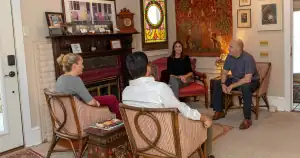
Our Venice office is located at 200 Capri Isles Blvd, Suite 7G, Venice, FL 34292. The office is designed to provide a comfortable, professional environment for the sensitive conversations that couples therapy involves.
Saturday appointments are available — an important consideration for working couples who can’t easily coordinate midweek schedules. Many couples find that attending together requires a time when neither partner is rushing from work or distracted by the rest of the day’s demands.
The first session is structured as an assessment. The psychologist meets with both partners together to understand the relationship history, the current concerns, and each person’s goals for treatment. Depending on the clinical picture, individual sessions with each partner may follow to gather information that’s better explored privately.
Treatment duration varies, but most couples benefit from 8 to 20 sessions. Some couples with clearly defined, recent-onset issues may see meaningful improvement sooner. Others with longstanding patterns or complex individual histories may benefit from longer-term work. Your psychologist will provide a realistic estimate after the initial evaluation.
Our Venice office serves couples throughout South Sarasota County, including North Port, Englewood, Nokomis, and Osprey. We also see couples at our Sarasota office at 1608 Oak Street. Our team of doctoral-level psychologists includes providers experienced in evidence-based couples modalities.
When Couples Therapy Isn’t Enough
Ethical transparency requires acknowledging that couples therapy doesn’t save every relationship — and that saving the relationship isn’t always the appropriate goal.
When individual therapy is needed alongside couples work, we recommend it. Some issues — active addiction, untreated PTSD, severe depression — need to be addressed individually before couples work can be effective. A psychologist can help determine when parallel individual treatment is necessary.
When separation is the appropriate outcome, couples therapy can serve a different but equally valuable purpose: helping partners separate with clarity, dignity, and — when children are involved — a co-parenting framework that protects the children’s wellbeing. Not every ending is a failure. Sometimes the healthiest outcome is a relationship that ends well rather than one that continues badly.
When one partner refuses to participate, individual therapy can still help the willing partner understand relationship dynamics, set boundaries, and make informed decisions about the future. Our relationship issues resources provide additional guidance for navigating these situations.
Premarital counseling is also worth mentioning. While this article focuses on couples in distress, working with a psychologist before problems escalate — particularly before major life transitions like marriage, relocation, or retirement — can build communication skills and identify potential areas of conflict before they become entrenched. Preventive work is almost always shorter and more effective than repair work.
For couples where one partner is dealing with a significant life stressor — a health diagnosis, job loss, grief, or family conflict — couples therapy can help the other partner understand how to be supportive without becoming a caretaker, and help the affected partner accept support without feeling diminished. These are not simple relationship problems; they’re complex adaptive challenges that benefit from professional guidance.
Our Venice office offers Saturday appointments from 9am to 4pm, making it easier for both partners to attend sessions together without disrupting their work schedules during the week.
Explore our full range of services to find the right approach for your needs.
Couples who engage in therapy earlier, before resentment becomes deeply embedded, consistently show better outcomes in research. If you have been considering whether to reach out, that question itself often signals that professional support could make a meaningful difference.
Frequently Asked Questions
How long does couples therapy take?
Most couples benefit from 8 to 20 sessions, typically held weekly or biweekly. The duration depends on the complexity and duration of the issues, the presence of individual mental health factors, and the couple’s engagement with the process. Your psychologist will provide an estimated timeline after the initial assessment.
What if my partner doesn’t want to go?
This is common, and it doesn’t mean therapy can’t help. Individual therapy can help you understand your role in relational dynamics, develop communication strategies, and make clear-eyed decisions about the relationship. Sometimes, when one partner begins individual work and starts changing their own patterns, the other partner becomes willing to engage.
Is couples therapy covered by insurance?
We are a private pay practice and do not accept insurance directly. We accept cash, check, and Zelle. We provide superbills that you can submit to your insurance company for potential out-of-network reimbursement. The reimbursement rate varies by plan.
Can you see us on Saturdays?
Yes. Our Venice office offers Saturday appointments from 9 a.m. to 4 p.m. Saturday availability is particularly popular with couples, as it allows both partners to attend without disrupting their work schedules.
Do you treat both married and unmarried couples?
Yes. Our couples work is not limited to married partners. We work with dating couples, engaged couples, cohabiting partners, and couples at any stage of their relationship. The principles of evidence-based couples therapy apply regardless of legal status.
References
- The Gottman Institute. (2024). The effectiveness of the Gottman method. https://www.gottman.com/about/research/effectiveness-of-gottman-method/
- The Gottman Institute. (2024). Research. https://www.gottman.com/about/research/
- American Psychological Association. (2024). Marriage and divorce. https://www.apa.org/topics/marriage-divorce
- Davoodvandi, M., Navabi Nejad, S., & Farzad, V. (2018). Examining the effectiveness of Gottman couple therapy on improving marital adjustment and couples’ intimacy. Iranian Journal of Psychiatry, 13(2), 135–141. https://pubmed.ncbi.nlm.nih.gov/29997659/
- Davoodvandi, M., et al. (2018). Examining the effectiveness of Gottman couple therapy. Iranian Journal of Psychiatry, 13(2), 135–141. https://pmc.ncbi.nlm.nih.gov/articles/PMC6037577/
- National Institute of Mental Health. (2023). Caring for your mental health. https://www.nimh.nih.gov/health/topics/caring-for-your-mental-health
- Substance Abuse and Mental Health Services Administration. (2024). Mental health. https://www.samhsa.gov/mental-health
- National Alliance on Mental Illness. (2024). Home. https://www.nami.org/
- Garanzini, S., et al. (2017). Results of Gottman method couples therapy with gay and lesbian couples. Journal of Marital and Family Therapy, 43(4), 674–684. https://pubmed.ncbi.nlm.nih.gov/28940625/
- Mayo Clinic. (2024). Marriage counseling. https://www.mayoclinic.org/tests-procedures/marriage-counseling/about/pac-20385249
Get Professional Help from Licensed Psychologists
Our doctoral-level psychologists in Sarasota and Venice can help with your mental health needs.
Call (941) 702-2457 to schedule a consultation.