
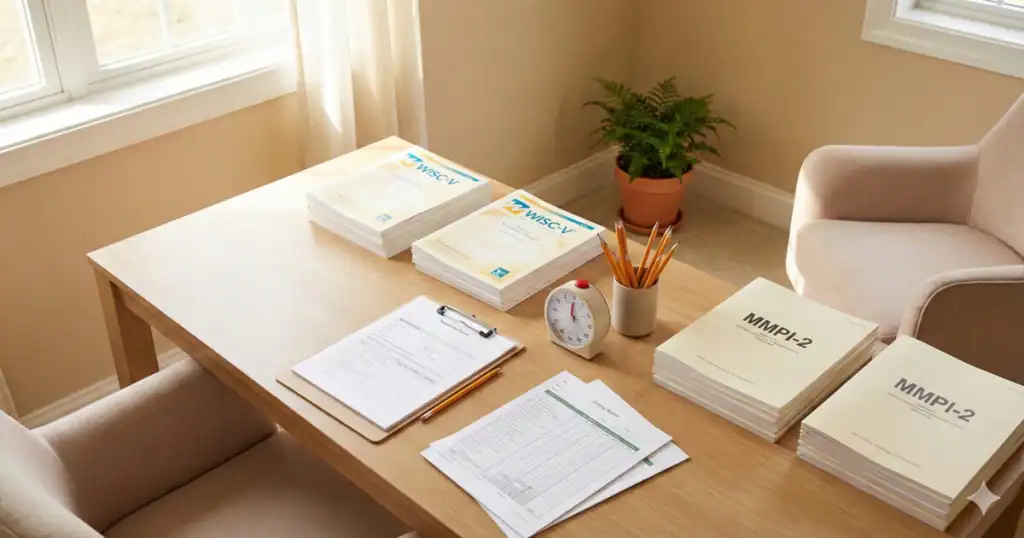
What Is Psychological Testing?
If a teacher, pediatrician, or school counselor has ever told you “your child might benefit from testing,” you’re not alone in wondering what that actually means. Psychological testing is a structured, standardized process used to evaluate how a child thinks, learns, processes emotions, and behaves. It goes far beyond a single IQ number — a comprehensive evaluation produces a detailed map of your child’s cognitive strengths, academic skills, emotional functioning, and behavioral patterns.
It helps to understand the terminology. Psychological testing is the broad umbrella term for any formal assessment conducted by a licensed psychologist. Psychoeducational testing focuses specifically on the relationship between cognitive ability and academic achievement — this is what schools typically request when a child is struggling academically. Neuropsychological assessment examines brain-behavior relationships in greater depth, looking at memory, attention, processing speed, executive function, and language in addition to cognitive and academic skills.
At our practice, we conduct comprehensive evaluations at our Sarasota office and Venice office, drawing from all three of these assessment traditions. A thorough evaluation typically involves 4–8 hours of direct testing spread across one to three sessions, plus parent and teacher questionnaires, a clinical interview, and extensive scoring and interpretation. The result is a detailed written report — usually 15 to 30 pages — with specific, actionable recommendations for home and school.
For billing and insurance purposes, psychological testing falls under CPT codes 96130–96131 (evaluation services) and 96136–96139 (test administration and scoring). Understanding these codes can be helpful when navigating insurance reimbursement.
Types of Psychological Tests for Children
A comprehensive evaluation is never a single test. It is a carefully selected battery of instruments chosen based on the referral question, the child’s age, and the clinical picture. Here are the major categories of tests your child’s psychologist may use.
Cognitive and IQ Testing
The Wechsler Intelligence Scale for Children, Fifth Edition (WISC-V) is the most widely used cognitive assessment for children ages 6–16. It measures verbal comprehension, visual-spatial reasoning, fluid reasoning, working memory, and processing speed. The Stanford-Binet Intelligence Scales are another well-validated option, particularly for younger children or those at the extremes of ability. A full cognitive evaluation typically takes 60–90 minutes and produces a detailed profile of how a child thinks — not just a single number.
Achievement Testing
The Woodcock-Johnson IV Tests of Achievement and the Wechsler Individual Achievement Test, Fourth Edition (WIAT-4) measure academic skills including reading, writing, and mathematics. Comparing achievement scores to cognitive ability is central to identifying learning disabilities — a child whose IQ is significantly higher than their academic performance may have a specific learning disorder that requires targeted intervention.
Behavioral and Emotional Assessment
Rating scales like the Behavior Assessment System for Children, Third Edition (BASC-3) and the Conners-3 gather structured information from parents, teachers, and sometimes the child about behavior, attention, emotional regulation, social functioning, and adaptive skills. These are combined with clinical interviews to build a comprehensive picture of a child’s functioning across settings.
Adaptive Behavior
The Vineland Adaptive Behavior Scales, Third Edition (Vineland-3) measures a child’s real-world functional skills in communication, daily living, socialization, and motor skills. Adaptive behavior assessment is essential for autism spectrum evaluations and developmental disability diagnoses, as it captures how a child actually functions in daily life — not just how they perform on a test.
Executive Function
The Behavior Rating Inventory of Executive Function, Second Edition (BRIEF-2) and the Delis-Kaplan Executive Function System (D-KEFS) assess attention, planning, organization, impulse control, cognitive flexibility, and working memory. Executive function deficits are common in ADHD, autism, traumatic brain injury, and some learning disabilities — and they often have a bigger impact on school performance than raw intelligence.
Autism-Specific Assessment
The Autism Diagnostic Observation Schedule, Second Edition (ADOS-2) is considered the gold-standard diagnostic tool for autism spectrum disorder. It uses structured and semi-structured activities to observe social communication, reciprocal interaction, and restricted or repetitive behaviors. It is always used alongside other measures — never in isolation — as part of a comprehensive diagnostic evaluation.

When Does a Child Need Psychological Testing?
Parents often wonder whether testing is truly necessary or if their child will simply “grow out of it.” While children do develop at different rates, certain patterns warrant formal evaluation rather than a wait-and-see approach.
Learning difficulties that persist despite tutoring or classroom interventions are one of the most common referral reasons. If a child has received extra help for several months and is still falling behind, the issue may be a specific learning disability that needs to be identified and addressed with targeted accommodations.
Suspected ADHD (ICD-10 F90.x) — when a child shows persistent patterns of inattention, hyperactivity, or impulsivity that interfere with functioning at school and home — requires comprehensive evaluation. ADHD is frequently overdiagnosed based on behavioral observation alone. A thorough assessment includes cognitive testing, continuous performance tests, behavioral rating scales, and clinical interviews to rule out other explanations for the observed behaviors.
Possible autism spectrum disorder (F84.0) should be evaluated when a child shows differences in social communication, restricted interests, or sensory sensitivities that affect daily functioning. Early identification leads to earlier intervention, which research consistently shows improves outcomes.
Emotional and behavioral concerns — including persistent anxiety (F41.x), depression (F32.x), emotional dysregulation, or behavioral outbursts — can be evaluated to determine whether a clinical diagnosis is appropriate and which treatment approach is most likely to help.
Giftedness identification and twice-exceptional (2e) profiles require comprehensive testing to capture the full picture. A child who is both intellectually gifted and has a learning disability, ADHD, or another condition needs evaluation that captures both the strengths and the challenges.
School requests for evaluation — whether for an Individualized Education Program (IEP) or a Section 504 plan — are another common pathway to testing. Parents have the right to request an independent educational evaluation if they disagree with the school’s findings or want a more comprehensive assessment.
Who Should Conduct Psychological Testing?
This is a critical question that many parents don’t think to ask. Not all professionals who administer tests are equally qualified to interpret them.
Doctoral-level psychologists (Psy.D. or Ph.D.) complete five to seven years of post-bachelor’s education, including extensive supervised training in psychological assessment. Licensure requires hundreds of hours of supervised testing before a psychologist can independently conduct evaluations. This training matters because interpreting a test battery is not about plugging numbers into a formula — it requires clinical judgment, pattern recognition, and the ability to integrate data from multiple sources into a coherent diagnostic picture.
School counselors, licensed mental health counselors (LMHCs), and other non-doctoral professionals may administer screening tools, but they are not trained or licensed to conduct comprehensive psychological evaluations. A screening is not a diagnosis. If your child needs a formal evaluation for ADHD, autism, a learning disability, or giftedness, a doctoral-level psychologist is the appropriate professional.
Comprehensive testing batteries — using multiple validated instruments to assess cognition, achievement, behavior, and emotional functioning — produce far more reliable and clinically useful results than single-test shortcuts. A single IQ score or a brief screening questionnaire cannot capture the complexity of how a child thinks, learns, and functions.

The Testing Process: What to Expect
Knowing what to expect can reduce anxiety for both parents and children. Here is a step-by-step overview of how comprehensive psychological testing works.
Initial Intake and Clinical Interview
The process begins with a parent interview — typically 60 to 90 minutes — where the psychologist gathers developmental history, medical history, family history, academic records, and the specific concerns that prompted the referral. This interview is essential for selecting the right test battery and for interpreting results in context.
Testing Sessions
Direct testing with the child typically takes four to eight hours, spread across one to three sessions depending on the child’s age and stamina. Younger children generally need shorter sessions with more breaks. The psychologist administers each test according to standardized procedures, observing not just the child’s answers but how they approach tasks, manage frustration, sustain attention, and interact with the examiner.
Parent and Teacher Questionnaires
Standardized rating scales are sent to parents and teachers to gather structured information about the child’s behavior and functioning across settings. Having multiple perspectives is essential — a child who appears fine in a one-on-one testing room may struggle significantly in a busy classroom.
Scoring, Interpretation, and Report Writing
After testing is complete, the psychologist scores all measures, analyzes patterns across instruments, and integrates the quantitative data with clinical observations and background information. This is the most intellectually demanding part of the process, and it is where the psychologist’s training and clinical judgment matter most. The written report typically runs 15 to 30 pages and includes scores, interpretive summaries, diagnostic conclusions, and specific recommendations.
Feedback Session with Parents
A feedback session — usually 60 to 90 minutes — walks parents through the findings, explains what the scores mean in practical terms, answers questions, and discusses recommendations for school, home, and treatment. This is often the most valuable part of the entire process for families, because it translates clinical data into actionable next steps.
Understanding Your Child’s Test Results
Test reports are full of numbers, and they can be overwhelming. Here are the key concepts that will help you make sense of your child’s results.
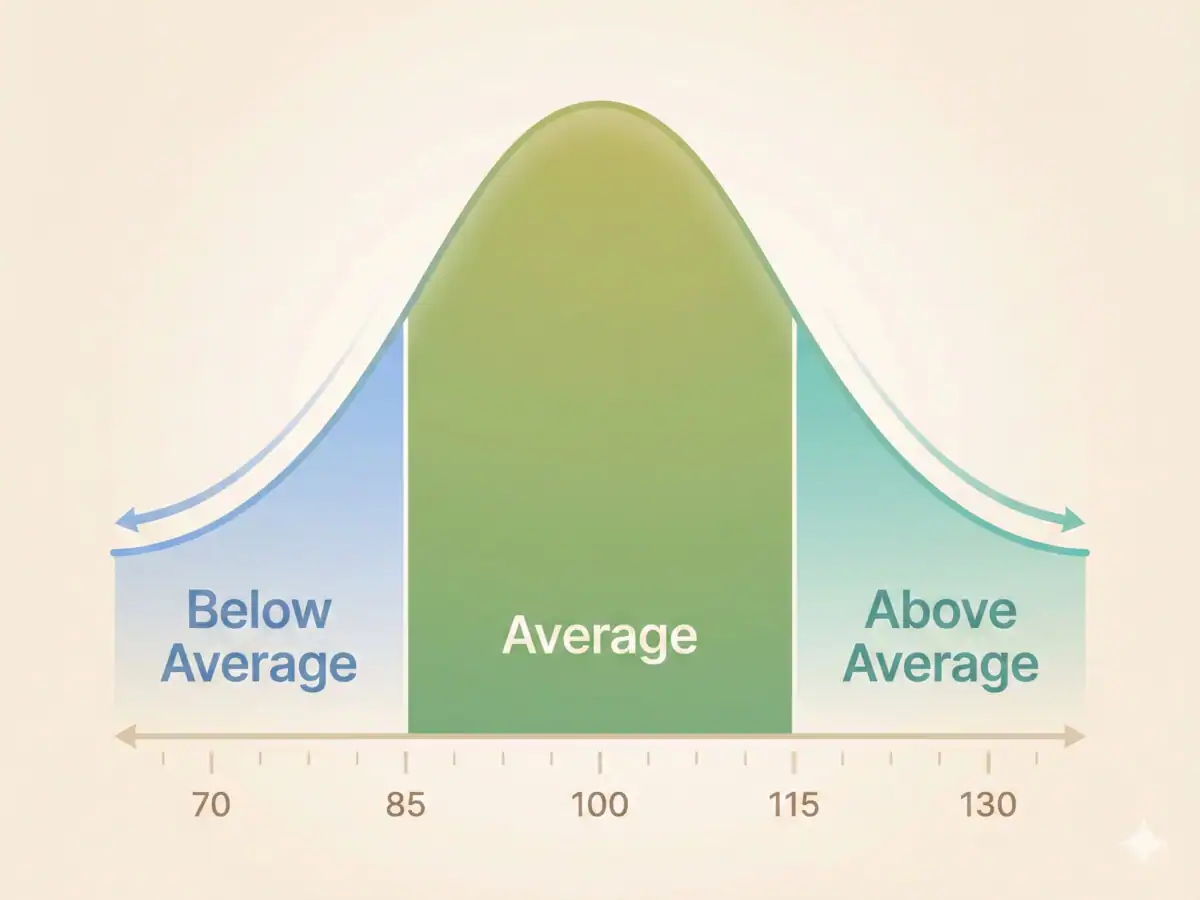
Standard scores have a mean of 100 and a standard deviation of 15. The “average range” is defined as 85–115, which encompasses roughly 68% of the population. A score of 100 means a child performed exactly at the 50th percentile compared to same-age peers.
Percentile ranks indicate what percentage of same-age children scored at or below your child’s score. A standard score of 115 falls at the 84th percentile, meaning the child scored as well as or better than 84% of peers. A score of 85 falls at the 16th percentile.
Confidence intervals acknowledge that all test scores contain some measurement error. A score reported as “105 (95% CI: 99–111)” means we are 95% confident the child’s true ability falls between 99 and 111. This is why psychologists focus on ranges rather than treating a single number as absolute truth.
Discrepancy analysis is where comprehensive testing provides its greatest value. When a child’s cognitive ability is significantly higher than their academic achievement, or when there is substantial scatter within their cognitive profile, it signals specific areas that need attention. A child with a verbal comprehension score of 130 and a processing speed score of 85 is going to have a very different experience in school than their overall IQ might suggest.
Finally, a good evaluation is strengths-based. Testing is not just about finding problems — it identifies what a child does well, which informs both treatment planning and educational programming. Understanding a child’s cognitive strengths gives parents and educators the tools to build on what works.
What Happens After Testing?
A comprehensive evaluation is only as useful as what happens next. The recommendations section of the report should provide a clear roadmap.
School accommodations are often the most immediate outcome. Depending on the findings, your child may qualify for a Section 504 plan (accommodations within the general education setting) or an Individualized Education Program (IEP, which provides specialized instruction). Common accommodations include extended time on tests, preferential seating, chunked assignments, and access to assistive technology.
Therapy recommendations are guided by the diagnostic findings. Cognitive Behavioral Therapy (CBT) is effective for anxiety and depression. Play therapy may be recommended for younger children. Social skills groups can address peer relationship difficulties. Executive function coaching helps children with ADHD or organizational weaknesses develop practical strategies.
Medication consultation may be recommended if the evaluation identifies ADHD or another condition where medication has strong research support. Psychologists do not prescribe medication — they refer to psychiatrists or developmental pediatricians for medication evaluation when appropriate.
Re-evaluation timelines are important to keep in mind. Schools typically require updated testing every three years for students receiving special education services. Cognitive and academic profiles can shift as children develop, so periodic re-evaluation ensures that accommodations and interventions remain appropriate.
Frequently Asked Questions
How much does psychological testing cost?
Comprehensive psychological evaluations typically range from $2,000 to $5,000 depending on the complexity and the number of tests administered. Many practices, including ours, are out-of-network providers who give clients a superbill — a detailed receipt that can be submitted to insurance for potential reimbursement. Contact your insurance company to ask about out-of-network benefits for CPT codes 96130–96131 and 96136–96139.
Will insurance cover psychological testing?
Coverage varies significantly by plan. Some plans cover psychological testing with out-of-network benefits; others require prior authorization or limit the number of testing hours. We recommend calling the number on the back of your insurance card and asking specifically about psychological testing benefits before scheduling.
How long does the full evaluation take?
From initial intake to feedback session, most evaluations take two to four weeks. Direct testing with the child takes four to eight hours across one to three sessions. Report writing and scoring require additional time. The feedback session is typically scheduled one to two weeks after the last testing session.
Can my child’s school do the same testing?
Schools can conduct evaluations, and they are required to do so at no cost when requested. However, school evaluations are often more limited in scope and focused specifically on educational eligibility rather than comprehensive diagnosis. A private evaluation typically provides a more thorough diagnostic picture, a wider range of recommendations, and a more detailed written report. Parents always have the right to request an independent educational evaluation (IEE) at district expense if they disagree with the school’s findings.
At what age can a child be tested?
Most standardized cognitive and developmental tests can be administered to children as young as two and a half to three years old. However, test results become more stable and predictive around age six. For very young children, developmental evaluations may use different instruments and approaches than evaluations for school-age children. Early evaluation is particularly important when autism spectrum disorder is suspected, as early intervention has significant long-term benefits.
References
- American Psychological Association. (2020). APA guidelines for psychological assessment and evaluation. https://www.apa.org/about/policy/guidelines-psychological-assessment-evaluation
- Wechsler, D. (2014). Wechsler Intelligence Scale for Children — Fifth Edition: Technical and interpretive manual. Pearson.
- Schrank, F. A., McGrew, K. S., & Mather, N. (2014). Woodcock-Johnson IV Tests of Achievement. Riverside.
- Reynolds, C. R., & Kamphaus, R. W. (2015). Behavior Assessment System for Children, Third Edition (BASC-3). Pearson.
- Conners, C. K. (2008). Conners 3rd Edition manual. Multi-Health Systems.
- Sparrow, S. S., Cicchetti, D. V., & Saulnier, C. A. (2016). Vineland Adaptive Behavior Scales, Third Edition. Pearson.
- Gioia, G. A., Isquith, P. K., Guy, S. C., & Kenworthy, L. (2015). BRIEF-2: Behavior Rating Inventory of Executive Function, Second Edition. PAR.
- Lord, C., Rutter, M., DiLavore, P. C., Risi, S., Gotham, K., & Bishop, S. L. (2012). Autism Diagnostic Observation Schedule, Second Edition (ADOS-2). Western Psychological Services.
- National Association of School Psychologists. (2020). Model for comprehensive and integrated school psychological services. https://www.nasponline.org/standards-and-certification/nasp-practice-model
- Individuals with Disabilities Education Act, 20 U.S.C. § 1400 (2004). https://sites.ed.gov/idea/
- U.S. Department of Education, Office for Civil Rights. (2020). Protecting students with disabilities. https://www.ed.gov/laws-and-policy/individuals-disabilities/section-504
- Sattler, J. M. (2018). Assessment of children: Cognitive foundations and applications (6th ed.). Jerome M. Sattler, Publisher.
- Flanagan, D. P., & Alfonso, V. C. (2017). Essentials of WISC-V assessment. Wiley.
- Mather, N., & Wendling, B. J. (2014). Essentials of WJ IV Tests of Achievement. Wiley.
- American Psychological Association. (2017). Ethical principles of psychologists and code of conduct. https://www.apa.org/ethics/code
- Braaten, E. B., & Felopulos, G. (2004). Straight talk about psychological testing for kids. Guilford Press.
Get Professional Help from Licensed Psychologists
Our doctoral-level psychologists in Sarasota and Venice can help with your mental health needs.
Call (941) 702-2457 to schedule a consultation.