

Why Proper ADHD Testing Matters More Than a Checklist
Your child’s teacher has mentioned attention issues again. Or maybe your pediatrician brought up ADHD at the last well-check. Perhaps you’ve been watching your child struggle with homework that should take 20 minutes but somehow stretches to two hours every night — and you’re wondering whether something more is going on.
If you’re searching for ADHD testing in Sarasota, you’ve likely already encountered conflicting information: online screeners that take five minutes, apps that claim to diagnose ADHD through a game, and telehealth services offering quick evaluations based on a single questionnaire. Here’s what our doctoral-level psychologists want you to understand: a comprehensive ADHD evaluation is not a checklist. It’s a detailed clinical process that identifies not just whether ADHD is present, but what kind, what else might be contributing, and exactly what will help.
That distinction makes the difference between a diagnosis that leads to real improvement and one that leads to ineffective treatment, unnecessary medication, or years of frustration.
What Is a Comprehensive ADHD Evaluation?
A thorough ADHD evaluation conducted by a licensed psychologist involves multiple components, multiple sessions, and multiple sources of information. The American Psychological Association’s clinical practice guidelines emphasize that ADHD cannot be reliably diagnosed through a brief office visit or a single rating scale (APA, 2024).
Clinical Interview and History
The evaluation begins with a comprehensive clinical interview — typically 60–90 minutes — where the psychologist gathers detailed information about your child’s developmental history, medical background, academic performance, social functioning, and family dynamics. For adult evaluations, this includes a retrospective look at childhood patterns, since ADHD is a neurodevelopmental condition that begins in childhood even when it’s not identified until adulthood (National Institute of Mental Health, 2024).
This phase also includes standardized rating scales completed by parents, teachers, and — when age-appropriate — the individual being evaluated. Gathering multiple perspectives is essential because ADHD symptoms often present differently across settings. A child might be highly focused during one-on-one time with a parent but completely dysregulated in a 25-student classroom at a Sarasota County elementary school.
Cognitive and Neuropsychological Testing
This is where a psychologist’s training becomes particularly valuable. Psychological testing goes beyond symptom checklists to measure the specific cognitive processes that ADHD disrupts: sustained attention, working memory, processing speed, impulse control, and executive functioning.
Common assessment tools include continuous performance tests (CPTs) that measure attention and impulsivity in real time, standardized IQ assessments that can reveal discrepancies between intellectual ability and performance, and executive function measures that evaluate planning, organization, and cognitive flexibility (CHADD, 2024).
These objective, standardized measures provide data that no clinical interview alone can capture. They also help identify whether other conditions — anxiety, learning disabilities, giftedness, sleep disorders, or processing deficits — are contributing to or mimicking ADHD symptoms.
Behavioral Observation
During testing sessions, the psychologist directly observes how your child approaches tasks, handles frustration, manages transitions between activities, and sustains effort over time. These clinical observations add a layer of information that rating scales and test scores cannot fully capture.
Why the “Quick Diagnosis” Approach Fails
The rise of telehealth-only ADHD assessments and 15-minute pediatric screenings has created a significant problem: misdiagnosis. Some children diagnosed with ADHD through brief screenings may not meet full diagnostic criteria when evaluated comprehensively.
Misdiagnosis goes in both directions. Some children receive an ADHD diagnosis when the real issue is anxiety — which can look remarkably similar in a classroom setting. An anxious child may appear distracted and restless, but treating them for ADHD won’t address the underlying worry driving their behavior. Conversely, some children with genuine ADHD are told they’re “just lazy” or “need more discipline” because their presentation doesn’t match the hyperactive stereotype.
The three presentations of ADHD — predominantly inattentive, predominantly hyperactive-impulsive, and combined — require different treatment strategies. The inattentive type, which disproportionately affects girls and often goes undiagnosed longer, may not involve any visible hyperactivity at all (Centers for Disease Control and Prevention, 2024). A comprehensive evaluation identifies the specific presentation and tailors recommendations accordingly.
What Conditions Can Mimic ADHD?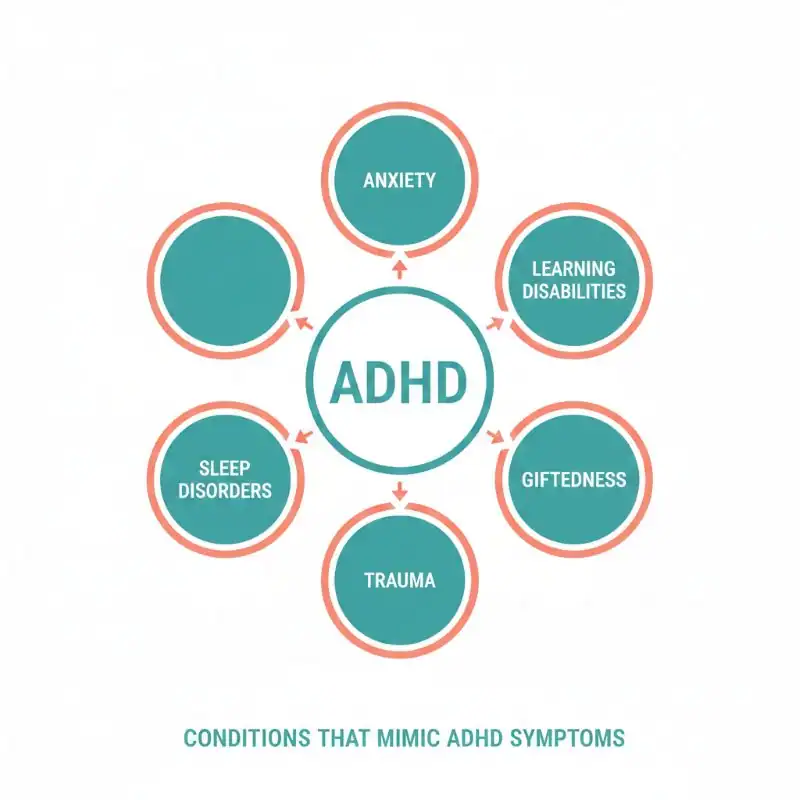 Several conditions share symptoms with ADHD, making comprehensive testing essential.
One of the most critical functions of a thorough evaluation is ruling out conditions that share symptoms with ADHD. In our Sarasota and Venice offices, our psychologists routinely encounter children referred for ADHD testing who actually have one or more of the following:
Anxiety disorders. Anxious children may appear inattentive because their minds are preoccupied with worry. They may seem restless because anxiety produces physical agitation. A child who can’t focus on math might not have an attention deficit — they might be consumed by worry about an upcoming social situation or fear of making a mistake (Anxiety and Depression Association of America, 2024).
Learning disabilities. A child with an undiagnosed reading disorder (dyslexia) or math disorder (dyscalculia) may appear inattentive during academic tasks — not because they can’t focus, but because the material is inaccessible to them. Comprehensive testing can identify these specific learning differences.
Giftedness and twice-exceptionality. Intellectually gifted children who are understimulated in the classroom often display restlessness, off-task behavior, and difficulty following through on assignments they find unchallenging. Some children are both gifted and have ADHD — a “twice-exceptional” (2e) profile that requires nuanced evaluation to identify (National Association for Gifted Children, 2024).
Sleep disorders. Chronic sleep deprivation produces symptoms that are virtually indistinguishable from ADHD in children: poor concentration, irritability, hyperactivity, and impaired memory. In Florida’s warm climate, where many children have disrupted sleep from allergies, humidity, or inconsistent schedules, sleep-related attention problems are more common than many parents realize (Hvolby, 2015).
Trauma and adverse childhood experiences. Children who have experienced trauma may be hypervigilant, easily startled, have difficulty concentrating, and appear emotionally dysregulated — all behaviors that can be mistaken for ADHD. The treatment for trauma-related attention difficulties is fundamentally different from ADHD treatment.
What to Expect from ADHD Testing in Sarasota
If you bring your child to our practice for ADHD evaluation, here’s what the process typically looks like:
Before the Evaluation
After scheduling, you’ll receive intake paperwork including a detailed developmental questionnaire, behavior rating scales, and release forms so we can gather information from your child’s school. We’ll ask you to share recent report cards, any previous testing results, and relevant medical records. The more information we have going in, the more accurate and efficient the evaluation will be.
The Evaluation Sessions
A comprehensive ADHD evaluation typically involves 4–8 hours of total contact time, spread across 2–3 appointments. This includes the parent interview, direct testing with your child, and a feedback session where results are reviewed.
Testing sessions with children are designed to be engaging rather than stressful. Our psychologists use a mix of structured tests and less formal activities, with breaks built in. Most children — even those who struggle significantly with attention — manage well because the tasks are varied and the psychologist is attuned to their energy and engagement level.
The Comprehensive Report
Following testing, you’ll receive a detailed written report that includes all test results with clear explanations, a diagnostic determination, specific recommendations for home, school, and — when warranted — medication consultation. This report is typically 15–25 pages and serves as a roadmap for supporting your child going forward.
If the evaluation reveals that a 504 plan or Individualized Education Program (IEP) is appropriate, the report is written to include the documentation Sarasota County schools need to implement accommodations. Our psychologists are experienced in communicating with local schools and can attend school meetings when needed.
The Feedback Session
This is arguably the most important appointment. The feedback session is where your psychologist walks you through results in plain language, answers every question you have, and helps you understand not just the diagnosis but the why behind your child’s struggles. Many parents describe this session as the moment things finally “click” — when years of confusing behavior suddenly make sense.
ADHD Testing for Adults in Sarasota
ADHD doesn’t end in childhood. Research estimates that approximately 60% of children with ADHD continue to experience significant symptoms in adulthood (Faraone et al., 2021). Many adults are first diagnosed in their 30s, 40s, or later — often after their own child receives a diagnosis and they recognize the same patterns in themselves.
Adult ADHD evaluation follows a similar structure but focuses on how attention difficulties affect work performance, relationships, time management, emotional regulation, and daily functioning. Adults who have spent decades developing compensatory strategies may have a more subtle presentation that requires the kind of nuanced assessment only a doctoral-level psychologist can provide.
Our Sarasota office and Venice office both conduct comprehensive ADHD evaluations for adults as well as children and adolescents.
What Happens After a Diagnosis?
An ADHD diagnosis is the beginning of a treatment path, not the end of a process. Based on the evaluation findings, your psychologist will recommend a tailored combination of approaches:
Behavioral strategies and skills training. This includes organizational systems, time management techniques, and executive function coaching. For children, parent training in behavioral management strategies is one of the most effective interventions available — especially for children under 6, where behavioral approaches are recommended as first-line treatment before medication (American Academy of Pediatrics, 2023).
Therapy. CBT adapted for ADHD helps individuals develop practical strategies for managing attention, impulsivity, and emotional regulation. For children, this often involves both individual sessions and parent coaching components. Acceptance and Commitment Therapy (ACT) has also shown promise for adults with ADHD who struggle with the frustration and self-criticism that often accompany the condition.
School or workplace accommodations. With a formal evaluation report, individuals can access accommodations such as extended time on tests, preferential seating, reduced-distraction testing environments, and organizational support. For Sarasota County students, these accommodations can be implemented through a 504 plan or IEP.
Medication consultation referral. When medication is warranted, we refer to trusted local psychiatrists and pediatric neurologists in the Sarasota–Venice area for medication evaluation and management. Our psychologists continue to provide therapy and monitor progress in coordination with the prescribing physician.
Frequently Asked Questions
How much does ADHD testing cost in Sarasota?
Comprehensive ADHD evaluations typically range from $1,500 to $3,500 depending on the complexity and scope of testing. While this is a significant investment, it provides the detailed, individualized information needed to guide effective treatment — something a brief screening cannot offer. Many families use out-of-network insurance benefits to offset costs, and our office can provide documentation for insurance reimbursement.
Can my pediatrician diagnose ADHD?
Pediatricians can screen for ADHD and may make a preliminary diagnosis based on rating scales and clinical observation. However, they typically do not conduct the kind of comprehensive neuropsychological testing that identifies the specific cognitive profile, rules out other conditions, and generates the detailed recommendations needed for school accommodations and targeted treatment. When a pediatrician suspects ADHD, a referral to a psychologist for comprehensive evaluation is the gold standard approach.
How long does ADHD testing take?
A comprehensive evaluation typically involves 4–8 hours of total assessment time spread across 2–3 sessions, plus a feedback session. The written report is usually completed within 2–3 weeks after testing. While this is more time-intensive than a quick screening, the depth of information you receive makes the investment worthwhile.
At what age can a child be tested for ADHD?
While ADHD symptoms can be present as early as preschool age, comprehensive testing is most reliable starting around age 5–6, when children can participate in standardized assessments. For younger children showing significant behavioral concerns, our psychologists can conduct developmental evaluations and behavioral assessments that inform early intervention strategies even before a formal ADHD diagnosis is appropriate.
What if the testing shows it’s not ADHD?
This is one of the most valuable outcomes of a comprehensive evaluation. If testing reveals that attention difficulties stem from anxiety, a learning disability, sleep issues, giftedness, or another condition, you now know exactly what to address — and you can avoid the frustration and expense of ADHD-targeted treatments that wouldn’t have helped. Knowledge is always the first step toward effective support.
Making the Decision to Get Tested
If you’ve been considering ADHD testing for your child or yourself, the evaluation process is designed to provide clarity. You’ll leave with a thorough understanding of cognitive strengths and challenges, a clear diagnostic picture, and specific, actionable recommendations.
Our practice serves families across Sarasota, Venice, Lakewood Ranch, Siesta Key, Palmer Ranch, Osprey, North Port, and surrounding Southwest Florida communities. Whether you’re a parent who’s been watching your child struggle, or an adult who’s always felt like you had to work twice as hard to keep up, comprehensive testing can provide the answers you’ve been looking for.
References
American Academy of Pediatrics. (2023). Clinical practice guidelines for ADHD. https://www.aap.org/en/practice-management/
American Psychological Association. (2024). Clinical practice guideline for ADHD. https://www.apa.org/practice/guidelines/adhd-clinical-practice-guideline.pdf
Anxiety and Depression Association of America. (2024). ADHD and anxiety. https://adaa.org/understanding-anxiety/related-illnesses/other-related-conditions/adult-adhd
Centers for Disease Control and Prevention. (2024). ADHD diagnosis. https://www.cdc.gov/adhd/diagnosis/index.html
CHADD (Children and Adults with Attention-Deficit/Hyperactivity Disorder). (2024). Comprehensive evaluation for ADHD. https://chadd.org/understanding-adhd/
Faraone, S. V., Banaschewski, T., Coghill, D., et al. (2021). The world federation of ADHD international consensus statement. Neuroscience & Biobehavioral Reviews, 128, 789–818. https://pubmed.ncbi.nlm.nih.gov/33549739/
National Association for Gifted Children. (2024). Twice-exceptionality resources. https://www.nagc.org/news/twice-exceptionality
National Institute of Mental Health. (2024). Attention-deficit/hyperactivity disorder (ADHD). https://www.nimh.nih.gov/health/topics/attention-deficit-hyperactivity-disorder-adhd
Hvolby, A. (2015). Associations of sleep disturbance with ADHD: Implications for treatment. ADHD Attention Deficit and Hyperactivity Disorders, 7(1), 1–18. https://pubmed.ncbi.nlm.nih.gov/25127644/
Sibley, M. H., Arnold, L. E., Swanson, J. M., et al. (2022). Variable patterns of remission from ADHD in the multimodal treatment study of ADHD. American Journal of Psychiatry, 179(2), 142–151. https://doi.org/10.1176/appi.ajp.2021.21010032
Get Professional Help from Licensed Psychologists
Our doctoral-level psychologists in Sarasota and Venice can help with your mental health needs.
Call (941) 702-2457 to schedule a consultation.