
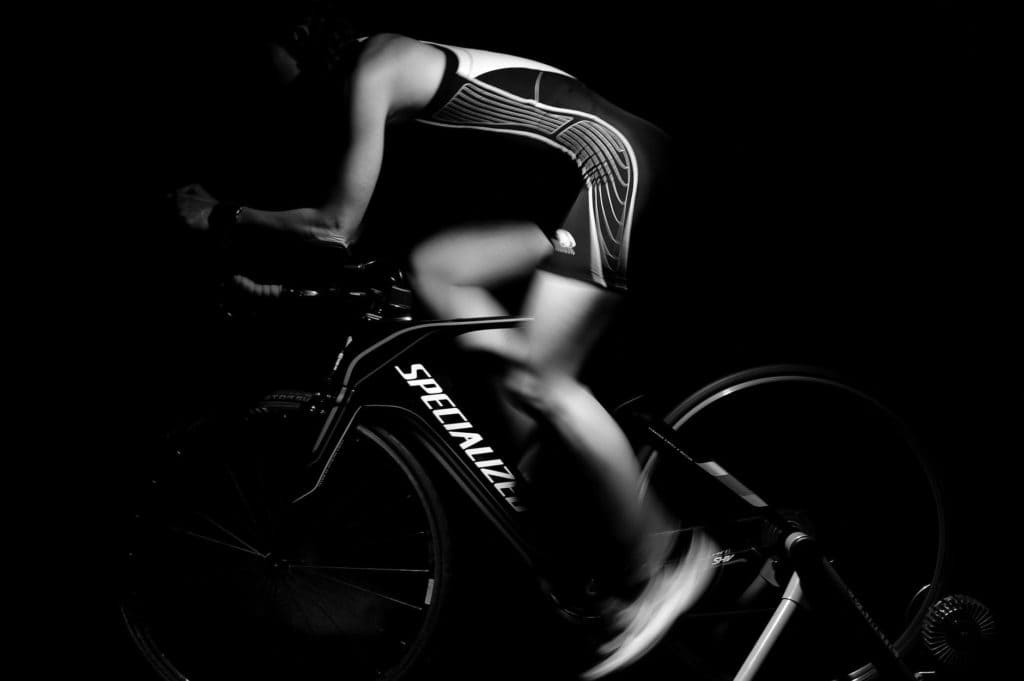
In competitive athletics, mental strength often determines the difference between winning and falling short. At Davenport Psychology, our team of licensed clinical psychologists provides comprehensive sports psychology services that help athletes at every level unlock their full potential. Unlike mental skills coaches, our doctoral-level psychologists are trained to address both performance optimization and underlying clinical issues that can impact athletic success.
Why Choose a Clinical Psychologist Over a Mental Skills Coach?
While mental skills coaches focus on performance techniques, licensed clinical psychologists offer a comprehensive advantage. Our doctoral training enables us to:
Identify and treat underlying clinical conditions such as performance anxiety, depression, or burnout that may manifest as performance struggles. What appears to be a “slump” might actually be clinical anxiety or depression requiring professional treatment.
Provide evidence-based interventions supported by peer-reviewed research and endorsed by the American Psychological Association (APA). Our approach goes beyond motivational coaching to address the neurological and psychological factors that influence performance.
Offer confidential mental health support under the same ethical and legal protections as traditional therapy. This matters for professional athletes dealing with media scrutiny, contract pressures, or career transitions.
Our clinical expertise allows us to differentiate between mental skills training needs and clinical treatment needs—then provide both when necessary. This is the advantage of working with our team of doctoral-level psychologists.
Our Evidence-Based Approach to Athletic Performance
We integrate powerful, scientifically-validated techniques to build sustainable mental performance:
Cognitive Behavioral Therapy (CBT) for Athletes
CBT helps athletes identify and modify thought patterns that interfere with performance. Research published in The Sport Psychologist demonstrates that CBT-based interventions significantly reduce performance anxiety and enhance competitive outcomes.
Application: Transform negative self-talk (“I always choke under pressure”) into performance-enhancing cognitions (“I’m prepared and focused on executing my game plan”).
Visualization and Mental Imagery Training
Mental rehearsal activates the same neural pathways as physical practice. Our psychologists teach athletes to create detailed, multi-sensory mental simulations that improve muscle memory and decision-making under pressure.
Application: Basketball players visualize successful free throws; golfers mentally rehearse each shot before execution.
Mindfulness-Based Stress Reduction (MBSR)
Adapted specifically for athletes, MBSR training improves present-moment awareness, emotional regulation, and the ability to achieve “flow state”—the optimal performance zone where everything clicks.
Application: Learn to quiet mental chatter, manage pre-competition nerves, and maintain focus despite external distractions.
Goal-Setting and Performance Planning
We help athletes develop SMART goals (Specific, Measurable, Achievable, Relevant, Time-bound) that create clear roadmaps from current performance to aspirational outcomes.
Application: Break down long-term goals (making varsity, earning a scholarship, going pro) into daily, actionable steps.
Team Dynamics and Communication
Athletic success often depends on team cohesion. Our psychologists work with athletes to improve communication with teammates, navigate conflicts with coaches, and manage family pressures around performance.
For athletes in the greater Sarasota-Manatee region, we offer sessions at both our Sarasota office in downtown’s historic district and our Venice office in Capri Isles, making evidence-based sports psychology accessible throughout the area.
Athletes We Work With
Research from the NCAA demonstrates that both preventative mental skills training and therapeutic support improve outcomes and well-being for athletes across all competitive levels. We tailor our approach to the unique pressures each athlete faces:
Youth & High School Athletes
Young athletes face immense pressure from parents, coaches, and peers while still developing their identity. We help youth athletes:
- Build confidence without tying self-worth entirely to athletic performance
- Manage academic demands alongside training schedules
- Develop healthy relationships with competition and failure
- Navigate social media pressures and comparison culture
- Maintain enjoyment and intrinsic motivation for their sport

Specialist for Youth Athletes: Dr. Keri Downs, a former Division I athlete at Dartmouth College, combines clinical expertise with firsthand understanding of youth sports pressures.
Collegiate & NCAA Athletes
College athletes balance rigorous academic requirements with elite athletic demands. We support collegiate athletes with:
- Time management and academic-athletic balance
- Dealing with team selection, playing time, and position changes
- Managing injury recovery and return-to-play anxiety
- Navigating NIL (Name, Image, & Likeness) opportunities and social media presence
- Preparing for life beyond college athletics
- Addressing substance use pressures and social challenges
Professional & Elite Athletes
Professional athletes face unique mental health challenges that require specialized clinical support:
- Managing media scrutiny and public criticism
- Handling contract negotiations and performance-based financial pressure
- Planning for career longevity and eventual retirement
- Coping with injuries that threaten career viability
- Addressing isolation and relationship challenges
- Maintaining mental health during travel and irregular schedules
All sessions are completely confidential, adhering to the same strict ethical standards as traditional psychotherapy.
Sport-Specific Mental Performance Training
While the fundamentals of sports psychology apply across disciplines, we’ve developed specialized expertise in several sports popular in Southwest Florida:
Golf Psychology

Mental performance determines success in golf more than almost any other sport. The “yips,” performance anxiety on crucial putts, and maintaining focus across 18 holes all respond to targeted psychological intervention.
What we address:
- Pre-shot routines and mental preparation
- Managing frustration after bad shots
- Staying present rather than score-watching
- Competitive anxiety in tournaments
- Mental recovery between rounds
Our approach: If your mind isn’t “right,” your swing won’t be either. We serve as your mental game coach, optimizing the connection between thoughts, emotions, and execution.
Ready to improve your mental game? Contact our team at (941) 702-2457.
Rowing & Crew
We’ve worked extensively with local competitive rowers, understanding the unique mental demands of the sport whether you scull or sweep, race singles or eights.
What we address:
- Pain tolerance and mental toughness during pieces
- Synchronization and team cohesion (especially in eights)
- Race strategy and mental pacing
- Managing pre-regatta anxiety
- Bouncing back from disappointing performances
Our psychologists understand rowing from both clinical and experiential perspectives. We’ll help you identify mental barriers and develop strategies to perform at your peak when the regatta horn sounds.
Polo
Polo demands split-second decision-making while managing a 1,200-pound animal at high speeds. The mental game in polo involves unique challenges that benefit from psychological expertise.
What we address:
- Managing pre-match nerves without losing competitive edge
- Staying focused during long tournaments
- Team communication and role clarity
- Frustration management during difficult games
- Confidence after falls or mistakes
Our approach combines insights from neuroscience and clinical psychology to help you optimize the mind-body-horse connection that defines success in polo.
Poker & Competitive Gaming

While not traditional athletics, poker and competitive gaming require similar mental skills: sustained concentration, emotional regulation, pattern recognition under pressure, and resilience after setbacks.
What we address:
- Managing “tilt” (emotional reactivity to bad beats)
- Maintaining optimal decision-making during long sessions
- Reading opponents while controlling your own “tells”
- Bankroll management and risk tolerance
- Work-life balance for professional players
We’ve helped numerous poker players develop psychological frameworks for measuring and tracking their mental game, leading to improved decision-making and better long-term outcomes.
Gymnastics & Cheerleading

These sports involve unique mental challenges: executing skills with serious injury risk, performing under intense scrutiny, and maintaining confidence after falls.
Read our complete guide to sports psychology for gymnastics and cheerleading for deeper insights into the mental game of these demanding sports.
Basketball & Team Sports
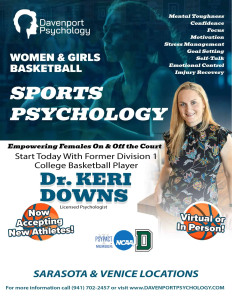
Team sports introduce social-emotional complexity alongside individual performance pressure. We’ve developed specific expertise in basketball mental performance, including our comprehensive off-season mental training program for women’s basketball players.
What we address:
- Role acceptance and coming off the bench
- Leadership development for captains
- Managing playing time changes
- Team chemistry and conflict resolution
- Pressure situations (final seconds, championship games)
Performing Arts & Actor Psychology
The performing arts demand a unique blend of vulnerability, precision, and resilience. Whether you are an actor preparing for an audition, a musician stepping onto the concert stage, or a dancer perfecting a routine, the psychological demands of performance are immense. At Davenport Psychology, our performance psychology services help performers at every level manage the mental challenges that come with a career on stage or screen.
What we address:
- Audition anxiety and stage fright management
- Performance confidence for actors, musicians, and dancers
- Managing rejection and career uncertainty in the performing arts
- Visualization and mental rehearsal techniques adapted for stage and screen performance
- Building resilience through CBT-based interventions tailored to performers
Our approach: We apply the same evidence-based performance psychology techniques used with elite athletes—including cognitive behavioral therapy, visualization, and mindfulness—to help performers develop the mental strength needed to thrive under pressure, recover from setbacks, and sustain a fulfilling career in the arts.
Meet Our Sports Psychology Specialists

Dr. Alejandro Sanchez, Psy.D. | Psychology Fellow
Athletic Performance Expertise: Dr. Sanchez specializes in helping athletes enhance performance through improved mental resilience and competitive anxiety management.
Clinical Approach: As a psychology fellow, Dr. Sanchez utilizes evidence-based techniques including cognitive restructuring, visualization training, and goal-setting frameworks. His approach is personalized to each athlete’s unique challenges, whether you’re overcoming performance anxiety, recovering from injury, or seeking that extra competitive edge.
Training: Doctoral degree in clinical psychology with specialized training in sports and performance psychology.

Dr. Keri Downs, Psy.D. | Licensed Clinical Psychologist
Unique Perspective: Dr. Downs brings a rare combination—she’s both a licensed clinical psychologist AND a former Division I athlete at Dartmouth College. This dual perspective means she understands athletic pressures from both clinical training and lived experience.
Youth Sports Expertise: Dr. Downs specializes in working with young athletes navigating the complex intersection of athletics, academics, social development, and family expectations. She understands the unique pressures facing youth and adolescent competitors.
Clinical Approach: Her evidence-based practice focuses on building mental resilience, managing performance anxiety, and helping young athletes maintain healthy relationships with competition and failure.

Elevate Your Game: Women’s Basketball Off-Season Mental Training with Davenport Psychology
Women’s basketball has entered a new era of visibility, intensity, and competition. The growth of the WNBA, record-breaking NCAA tournament
Sports Psychology for Gymnastics and Cheerleading at Davenport Psychology
Gymnastics and cheerleading occupy a unique space in competitive athletics. They combine the physical demands of power sports with the

How Weightlifting can Help with Anxiety
Don’t have time to read? Listen to our podcast or download it here! Anxiety disorders are the most common mental

Sports and performance psychology: Worthy or just a term?
Sports and performance psychology focuses on applying psychological rules that enhance the performance of an athlete. It can take an