
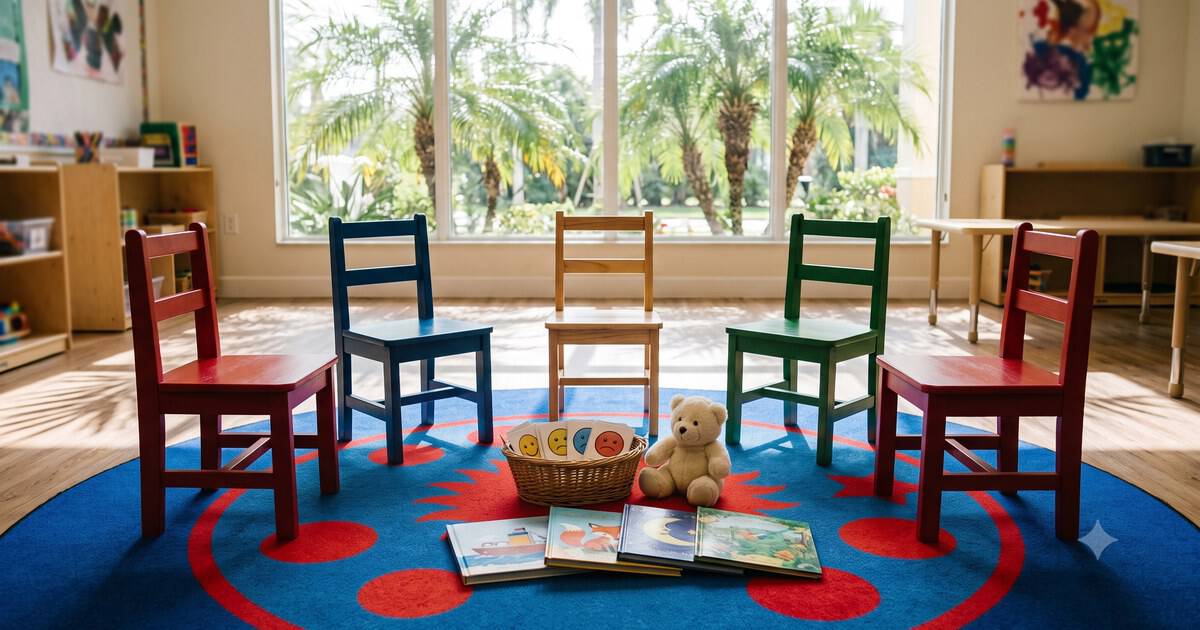
A five-Friday, in-person social-emotional learning program for homeschooling families at The Hub at Skye Ranch, Sarasota. Facilitated by Keri Downs, Psy.D. This is a non-clinical, psychoeducational program, not therapy and not a substitute for clinical care.
Program overview
Two age-banded groups meet consecutively on the same Friday mornings:
- Mindful Explorers, ages 4 to 7: 9:15 to 10:15 AM
- Mindful Minds, ages 7 to 12: 10:20 to 11:20 AM
Each session integrates mindfulness practice, emotional literacy, peer connection, and outdoor movement within a structured homeschool learning framework. Curriculum emphasizes self-regulation, cooperative skills, resilience, and healthy risk-taking, with parents welcomed as observers during first and last sessions.
Curriculum
Two age-banded cohorts run back-to-back each Friday morning at The Hub at Skye Ranch. Each session is 60 minutes. Each cohort meets for five sessions.
Mindful Explorers (ages 4 to 7) scope and sequence
An introduction to noticing, naming feelings and self-control for early-elementary students, taught through movement, play and hands-on activities at a pace suited to ages 4 to 7.
- Mindful Noticing. Through a five-senses noticing activity with movement around the room and outdoors, children take turns describing what they see, hear, feel and smell. By the end, a child can name what they notice with each of their senses.
- Identifying Emotions. Through guided discussion and hands-on activities, children match feeling words to the places they notice those feelings in the body. By the end, a child can name common feelings and point to where a feeling shows up for them.
- Worry Clouds and Calm Clouds. Through a drawing activity and guided slow belly breathing, children practice noticing that thoughts drift in and drift out again. By the end, a child can name a settling activity and demonstrate it when prompted.
- Self-Control and Turn-Taking. Through stop-and-go movement games played in pairs and small groups, children practice pausing before they act. By the end, a child can demonstrate a stop, think, choose sequence during a game and take turns with a partner.
- My Mindfulness Toolbox. Through review and a hands-on take-home activity, children gather the noticing and settling activities they liked best from the earlier sessions. By the end, a child can name a favorite activity and show a grown-up how to do it.
Mindful Minds (ages 7 to 12) scope and sequence
The same themes for upper-elementary and middle-grade students, taught through discussion, everyday scenarios and short written reflection, with more emphasis on thinking about one’s own thinking.
- Focus and Awareness. Through short attention exercises and paired discussion, students practice holding their attention on one thing and noticing the moment it drifts. By the end, a student can describe where their attention went and demonstrate bringing it back.
- Flexible Thinking. Through everyday scenarios worked through in small-group discussion, students practice separating a first thought from a checked fact. By the end, a student can distinguish a first thought from a checked fact and name one piece of evidence for or against it.
- Emotional Awareness. Through scenario work and group discussion, students practice recognizing and naming emotions in themselves and in others, including how one situation can land differently for different people. By the end, a student can name what they are feeling and explain what someone else might be feeling in the same situation.
- Managing Big Feelings. Through group discussion and practice, students compare strategies such as stepping away, slow breathing, movement and talking it through, and discuss when each one fits. By the end, a student can name two strategies that work for them and describe a situation where they would use each.
- Finding Flow. Through reflection and a short written plan, students identify the strategies they intend to keep practicing. By the end, a student can explain which strategies work best for them and describe how they plan to use them after the program ends.
The curriculum draws on an established evidence base in social and emotional learning, mindfulness, and developmental psychology (CASEL 2024; Cipriano et al. 2023; Diamond and Lee 2011; Durlak et al. 2011; Flook et al. 2015; Zelazo and Lyons 2012; Zenner et al. 2014).
Schedule: five Fridays
- Friday, 08/21/2026
- Friday, 08/28/2026
- Friday, 09/04/2026
- Friday, 10/09/2026
- Friday, 10/23/2026
Session handouts
Handouts are posted here after each Friday session. The parent guide summarises what the group covered and suggests a few things to try during the week — it is a short read, not homework. The activity sheets are optional: print one only if your child wants to keep going at home. Nothing here needs to be returned or completed.
Friday, 08/21/2026
Mindful Explorers (ages 4 to 7)
Today we became Mindful Explorers. We practised slowing down and using our five senses to notice details in the world around us. Mindfulness teaches young children to slow down long enough to notice what they see, hear, smell, feel and taste, which supports attention, emotional regulation and executive functioning. At home, try one activity a day: a nature walk hunting for something rough, smooth, tiny or interesting to smell; a mindful snack; a one-minute sound safari with eyes closed; or a colour hunt. At dinner, ask: what was something you noticed today that you usually miss?
- Parent take-home guide: Super Senses — PDF, 1 page
- Super Sense Scavenger Hunt — optional print-at-home activity, PDF, 1 page
Mindful Minds (ages 7 to 12)
Today we learned that everyone’s attention wanders. The goal of mindfulness is not to stay perfectly focused, it is to notice when our attention has wandered and gently bring it back. Attention works like a muscle: every time children notice a distraction and intentionally refocus, they strengthen attention, self-regulation and executive functioning. At home, try one activity a day: read for five minutes with no distractions, complete a puzzle, draw quietly, build with LEGO, or sit outside and find ten things you have never noticed before. Then ask: what distracted you? How did you notice? What helped you come back?
- Parent take-home guide: Attention Training — PDF, 1 page
- My Attention Tracker — optional print-at-home worksheet, PDF, 1 page
Friday, 08/28/2026
Handouts are posted here after each session.
Friday, 09/04/2026
Handouts are posted here after each session.
Friday, 10/09/2026
Handouts are posted here after each session.
Friday, 10/23/2026
Handouts are posted here after each session.
Location
The Hub at Skye Ranch
9200 Starry Night Avenue
Sarasota, FL 34241
Enrollment fees
This program is offered at a promotional rate specific to the Skye Ranch venue partnership:
- $35 per session
- $175 total for the five-session program
- Billing cadence: pay-as-you-go after each session is delivered. Families are billed for sessions their child actually attends.
- No additional materials fees: all curriculum materials, handouts, and activity supplies are included.
The $35 rate is specific to this Fall 2026 Skye Ranch program and reflects a venue-partnership discount. It does not represent Davenport Psychology’s general homeschool programming rate.
Facilitator
Keri Downs, Psy.D. (FL PY11909), leads all sessions. Dr. Downs delivers this program in a psychoeducational, non-clinical capacity under the Davenport Psychology homeschool programming line. Clinical services remain available separately at Davenport Psychology.
Payment options
- Step Up For Students FES-UA scholarship: Skye Ranch Homeschool Enrichment is live on the Step Up Empowered Marketplace, so FES-UA families can reserve funds now. Reserve the full amount for the program, then request payment to us in EMA after each session has been delivered.
- Step Up For Students PEP scholarship: same Home Education Instructional Program category. PEP families can reserve funds now in the same way.
- Self-pay: Zelle. Payment details are provided at enrollment.
How to reserve your scholarship funds
- Sign in to your EMA parent account at apply.stepupforstudents.org.
- Go to the Marketplace.
- In the provider search, type Davenport Psychology and select Charles R. Davenport, Psy.D., LLC d/b/a Davenport Psychology.
- Open our provider page and choose Skye Ranch Homeschool Enrichment. It is the one priced at $35 per session.
- Reserve the full amount. The total is $175 for all five Fridays.
Program disclosures
This is a non-clinical, psychoeducational program. Sessions do not constitute psychotherapy, counseling, or mental health treatment. No clinical records are generated. Enrollment is offered in accordance with Florida Statutes §490.014(4)(a) (educational-program exemption), §1002.41 (Home Education Program), and §1002.395 (Personalized Education Program).
Families needing clinical psychology services can access those separately through Davenport Psychology’s clinical intake.
Per the Davenport Psychology hybrid-entity designation under 45 CFR 164.504(g), this program is part of the practice’s non-health-care educational component under the statutory framing described above. The only record kept is an attendance roster used for enrollment and scholarship billing, which is an education record rather than a clinical record. No treatment record is created, and the program is not subject to the HIPAA Privacy Rule individual treatment provisions.
Registration
Enrollment is handled through a short online form and a signed Participation Agreement. Ready to enroll? Complete the enrollment form here. Questions? See our homeschool family services page or call (941) 702-2457.
Davenport Psychology
Phone: (941) 702-2457
Email: [email protected]
Charles R. Davenport, Psy.D., LLC d/b/a Davenport Psychology.