
Medically reviewed by Charles R. Davenport, Psy.D. on July 30, 2026
Last Updated July 30, 2026
The gifted homeschool kid who races through a math workbook and refuses to check the answers is not lazy. The one who keeps asking questions about the universe instead of finishing the writing prompt is not defiant. The one who has vanished into fantasy novels for three weeks and won't come out is not depressed, at least not necessarily. What all three often are is under-challenged. Underchallenge has a specific developmental signature, and it looks a lot like the behavioral problems parents think they're dealing with, which is why gifted underachievement is one of the most misread patterns in child psychology. Reis and McCoach's foundational review of gifted underachievement traces this misreading across decades of literature and lands on a clear takeaway: many bright kids who look unmotivated are actually responding rationally to material that doesn't ask enough of them (Reis and McCoach, 2000, Gifted Child Quarterly 44(3):152 to 170). The Belin-Blank Center's A Nation Deceived report reached the same conclusion for a policy audience and pushed hard for acceleration and level-matching as first-line interventions (Colangelo, Assouline, and Gross, 2004). None of this is about pushing kids harder. It's about matching the material to the mind that is actually in the room.
Book a free 15-minute call with Dr. Davenport
What Underchallenge Actually Looks Like at Home
Homeschool amplifies the underchallenge signal because parents see it up close. A classroom teacher with 22 kids can miss it. A parent at a kitchen table cannot. In my practice I see a few signatures often enough that they're the first questions I ask when a family brings in a bright child who "just won't do the work."
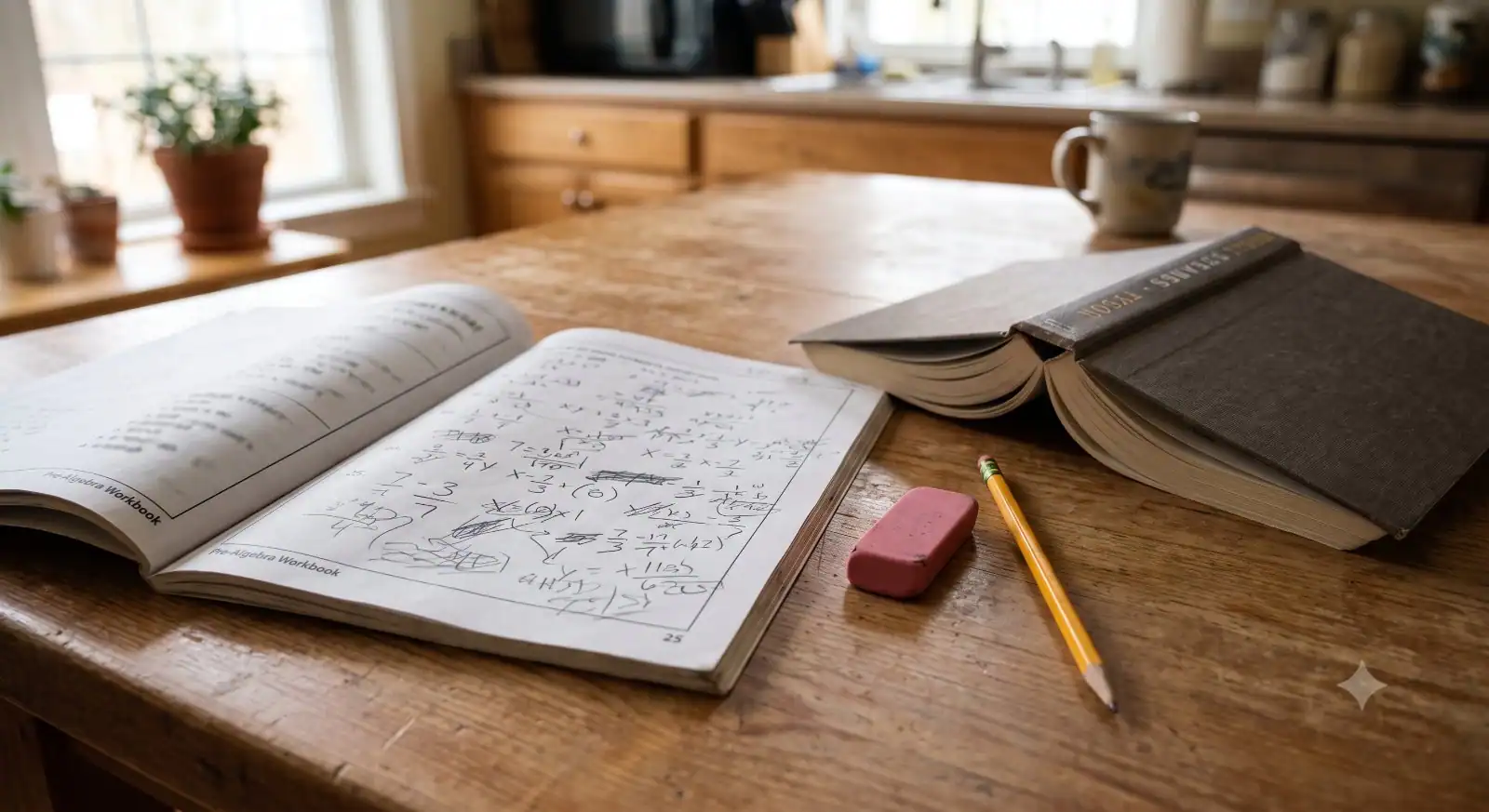
Racing through, then refusing to check. The kid finishes a 20-problem math page in six minutes. Half of it is right. Half of it has careless errors that would have been caught with one pass. When you ask her to check, she melts down. Parents read this as sloppiness or defiance. Often it's a bright kid who correctly perceives that the material was trivial and can't stomach the idea of spending more time on it than she already has.
Existential questions instead of the task. The writing prompt is "describe your favorite meal." The kid is asking whether time is real. This looks like distraction. I used to read it as avoidance. I don't anymore. In gifted kids it's often a cognitive-appetite signal: the prompt is too small to hold the mind, and the mind reaches for something meatier to chew on. That's information about the material, not about the child's willpower.
Retreat into fantasy or deep reading. The kid disappears into novels for hours a day and resists coming out for schoolwork. That's not always depression. Sometimes it's the only place the intellectual load is actually engaging.
A collapse of effort on shallow work paired with intense effort on self-directed projects. The workbook lies untouched. The self-designed model of the Roman aqueduct on the dining room table has been rebuilt three times. This pattern is nearly pathognomonic for underchallenge.
Perfectionism on the small stuff and abandonment on the deep stuff. Some gifted kids handle underchallenge by overinvesting in the trivial (perfect handwriting on a worksheet they finished in two minutes) and refusing to start anything that feels genuinely hard. That inverse pattern is worth watching for too.
Why Underchallenge Looks Like Something Else
The reason underchallenge gets misread as ADHD, oppositional behavior, learning disorder, or depression is that it produces overlapping surface features. Racing through work looks like inattention. Refusing to check looks like defiance. Retreat into fantasy looks like withdrawal. Existential drift looks like distractibility. The National Association for Gifted Children has spent years documenting how frequently gifted kids get misdiagnosed or misidentified when the underlying pattern is a mismatched educational level.
This is where the twice-exceptional question comes in. Some gifted kids are gifted AND have ADHD, or a specific learning disorder, or an autism spectrum profile. When those coexist, the giftedness often masks the disability and the disability masks the giftedness, so the child looks average and struggles in ways that don't add up. The Davidson Institute's resources on 2E identification and our own twice-exceptional page cover this masking pattern in more depth. If your gifted kid's underchallenge behaviors don't resolve when you actually raise the level, that's the moment to think about whether there's something else in the picture.
What Actually Helps
Reis and McCoach's review and the Nation Deceived meta-analysis point at roughly the same intervention set. Homeschool parents can implement most of this without any institutional permission, which is one of the real advantages of homeschooling gifted kids.
Curriculum compacting. Skip the practice the child clearly doesn't need. If she can demonstrate mastery in a pretest, move on. The classroom version of this requires a lot of institutional negotiation. The homeschool version requires a decision at breakfast.
Acceleration where appropriate. Grade skips, subject-specific acceleration (math three grades up, writing at grade level), or a full early transition into high school or college work. Meta-analytic research finds positive effects on academic achievement, with no evidence of harm to social-emotional outcomes (Steenbergen-Hu & Moon, 2010). Acceleration is one of the most-studied and least-used interventions in gifted education.
Depth over breadth. Instead of covering more material faster, go deeper into fewer topics. Joseph Renzulli's Schoolwide Enrichment Model, which translates well to homeschool contexts, argues that gifted learners thrive when they get sustained time on self-selected topics of genuine interest (Renzulli Center for Creativity, Gifted Education, and Talent Development).
Mentor projects. Match the child with an adult or older peer working on something the child wants to learn. Six months of an apprenticeship-style mentorship in birding or coding or historical research often does more for a gifted kid than a year of grade-level workbooks.
Mixed-age depth work. A twelve-year-old in a well-run adult book discussion group, or a nine-year-old sitting in on a high-schooler's Latin lesson, gets an intellectual environment matched to her mind.
Explicit tolerance-for-effort work. Some gifted kids have never had to try. When you raise the level, they'll hit real difficulty for the first time and it will be uncomfortable. That's not a signal the level is wrong. That's the actual work. The American Academy of Pediatrics guidance on gifted children mentions this frustration-tolerance piece as one of the more commonly missed developmental tasks in gifted kids.

What This Looks Like in a Florida Homeschool Family
I worked with a Venice family whose daughter, ten years old, was on her third math curriculum in eighteen months. Every one had failed the same way. She'd race through the first two weeks, get careless, refuse to check, and then dig in against doing any of it. Her parents were exhausted. She looked defiant on paper. When we tested her, her math reasoning was three years above grade level. Her working memory was strong. Her attention was fine. Her frustration tolerance was almost nonexistent, because she'd never had to develop it, because she'd never been given material that made her use it. The intervention wasn't a fourth curriculum. It was a subject-specific acceleration to material at her actual level plus a mentor project on Fibonacci sequences she'd been curious about for a year. Six months later she was doing algebra reasonably happily and had built enough tolerance for effort to slog through the parts she didn't like. Her parents did not push harder. They stopped asking her to solve problems she'd already solved.
When an Evaluation Actually Helps
A psychoeducational evaluation is worth considering when:
- You suspect giftedness but haven't confirmed it, and you want a cognitive profile before making curriculum decisions.
- Underchallenge behaviors persist even after you've raised the level, which raises the 2E masking question.
- There's real academic asymmetry (reading three years up, writing on grade, math above grade) and you want to know what's driving it.
- There's an emotional or behavioral piece (anxiety, perfectionism, social difficulty) you can't fully separate from the giftedness.
- You're considering a grade skip or a formal acceleration and want data to inform it.
The psychoeducational consultation option sits between "no formal work" and "full evaluation" and often gives homeschool families enough to make good curriculum decisions without a large evaluation. For families who need the full picture, our psychological testing page explains what a full evaluation covers. For Florida families, the FES-UA scholarship through Step Up for Students covers evaluation costs for qualifying homeschool families.
How to Get Started
If your gifted homeschool kid is dulling out under material that should engage them, we offer a free 15-minute call to help you sort what would actually be useful next. You can book a call here or reach our intake at (941) 702-2457. Our homeschool family services page describes how we work with homeschool families specifically, and our twice-exceptional page explains the masking pattern in more depth.
By Charles R. Davenport, Psy.D., Licensed Psychologist · FL License PY7978 · PSYPACT 15371
Medically reviewed by Charles R. Davenport, Psy.D. on July 30, 2026
Last Updated July 30, 2026
This article was written by Dr. Davenport from his clinical experience and the cited research literature. Read more about how we write our articles.
Dr. Davenport sees patients at our Sarasota office and our Venice office.
Disclaimer: This article is for general educational purposes and is not clinical advice or a substitute for evaluation by a licensed psychologist. If you or your child needs an evaluation or therapy, schedule a free 15-minute consultation.
If in crisis: Contact the 988 Suicide and Crisis Lifeline or your nearest emergency department.
References
- Reis, S. M., and McCoach, D. B. (2000). The underachievement of gifted students: What do we know and where do we go? Gifted Child Quarterly, 44(3), 152 to 170. https://journals.sagepub.com/doi/10.1177/001698620004400302
- Colangelo, N., Assouline, S. G., and Gross, M. U. M. (2004). A Nation Deceived: How Schools Hold Back America's Brightest Students. The Templeton National Report on Acceleration. https://accelerationinstitute.org/nation_deceived/
- Peters, S. J., Carter, J., and Plucker, J. A. (2020). Rethinking how we identify "gifted" students. Phi Delta Kappan. https://doi.org/10.1177/0031721720978055
- National Association for Gifted Children. Resources on identification, programming, and 2E learners. https://www.nagc.org/
- Renzulli Center for Creativity, Gifted Education, and Talent Development, University of Connecticut. Schoolwide Enrichment Model. https://gifted.education.uconn.edu/
- Davidson Institute. Twice-Exceptional Students. https://www.davidsongifted.org/gifted-blog/twice-exceptional-students/
- American Academy of Pediatrics, HealthyChildren.org. Educational Opportunities for Gifted Children. https://www.healthychildren.org/English/ages-stages/gradeschool/school/Pages/Educational-Opportunities-for-Gifted-Children.aspx
“`json
{
“@context”: “https://schema.org”,
“@graph”: [
{
“@type”: “MedicalWebPage”,
“@id”: “https://davenportpsychology.com/gifted-homeschool-kids-underchallenge-boredom-not-personality/#webpage”,
“url”: “https://davenportpsychology.com/gifted-homeschool-kids-underchallenge-boredom-not-personality/”,
“name”: “Gifted Homeschool Kids and Underchallenge: Boredom Is Not a Personality”,
“headline”: “Gifted Homeschool Kids and Underchallenge: Boredom Is Not a Personality”,
“description”: “What underchallenge looks like in gifted homeschool kids, why it gets misread as defiance or laziness, what actually helps, and when to consider a psychoeducational evaluation.”,
“inLanguage”: “en-US”,
“dateCreated”: “2026-07-30”,
“datePublished”: “2026-07-30T10:00:00-04:00”,
“dateModified”: “2026-07-30”,
“lastReviewed”: “2026-07-30”,
“medicalSpecialty”: [“https://schema.org/Psychiatric”, “Clinical Psychology”],
“audience”: {
“@type”: “MedicalAudience”,
“audienceType”: “Parents of gifted homeschool students”
},
“about”: [
{
“@type”: “Thing”,
“name”: “Gifted underachievement”,
“url”: “https://www.nagc.org/”
},
{
“@type”: “Thing”,
“name”: “Twice-exceptional (2E) learners”,
“url”: “https://davenportpsychology.com/conditions/support-for-gifted-twice-exceptional-2e-individuals/”
}
],
“author”: {“@id”: “https://davenportpsychology.com/#identity”},
“reviewedBy”: {“@id”: “https://davenportpsychology.com/#identity”},
“publisher”: {“@id”: “https://davenportpsychology.com/#organization”},
“isPartOf”: {“@id”: “https://davenportpsychology.com/#website”},
“breadcrumb”: {“@id”: “https://davenportpsychology.com/gifted-homeschool-kids-underchallenge-boredom-not-personality/#breadcrumbs”}
},
{
“@type”: “Person”,
“@id”: “https://davenportpsychology.com/#identity”,
“name”: “Charles R. Davenport, Psy.D.”,
“givenName”: “Charles”,
“familyName”: “Davenport”,
“honorificSuffix”: “Psy.D.”,
“jobTitle”: “Licensed Psychologist”,
“url”: “https://davenportpsychology.com/our-team-of-licensed-psychologists/charles-r-davenport-psyd/”,
“hasCredential”: [
{
“@type”: “EducationalOccupationalCredential”,
“credentialCategory”: “license”,
“name”: “Florida Licensed Psychologist PY7978”,
“url”: “https://mqa-internet.doh.state.fl.us/MQASearchServices/HealthcareProviders/LicenseVerification?LicInd=6671&ProCde=2701”
},
{
“@type”: “EducationalOccupationalCredential”,
“credentialCategory”: “license”,
“name”: “PSYPACT Authority to Practice Interjurisdictional Telepsychology 15371”,
“url”: “https://authorizations.psypact.gov/60bd1a4d-6ac5-43d8-8232-901ba377928d?record_view=true”
}
],
“sameAs”: [
“https://davenportpsychology.com/our-team-of-licensed-psychologists/charles-r-davenport-psyd/”
],
“worksFor”: {“@id”: “https://davenportpsychology.com/#organization”}
},
{
“@type”: [“Organization”, “MedicalBusiness”],
“@id”: “https://davenportpsychology.com/#organization”,
“name”: “Davenport Psychology”,
“legalName”: “Charles R. Davenport, Psy.D., LLC d/b/a Davenport Psychology”,
“url”: “https://davenportpsychology.com”,
“telephone”: “+19417022457”,
“email”: “[email protected]”,
“areaServed”: [“Sarasota, FL”, “Venice, FL”, “Florida”],
“location”: [
{
“@type”: “Place”,
“name”: “Sarasota Office”,
“address”: {
“@type”: “PostalAddress”,
“streetAddress”: “1608 Oak Street”,
“addressLocality”: “Sarasota”,
“addressRegion”: “FL”,
“postalCode”: “34236”,
“addressCountry”: “US”
},
“url”: “https://davenportpsychology.com/office-directory/sarasota-office/”
},
{
“@type”: “Place”,
“name”: “Venice Office”,
“address”: {
“@type”: “PostalAddress”,
“streetAddress”: “200 Capri Isles Blvd, Suite 7G”,
“addressLocality”: “Venice”,
“addressRegion”: “FL”,
“postalCode”: “34292”,
“addressCountry”: “US”
},
“url”: “https://davenportpsychology.com/office-directory/venice-psychology-office/”
}
]
},
{
“@type”: “WebSite”,
“@id”: “https://davenportpsychology.com/#website”,
“url”: “https://davenportpsychology.com”,
“name”: “Davenport Psychology”,
“publisher”: {“@id”: “https://davenportpsychology.com/#organization”}
},
{
“@type”: “BreadcrumbList”,
“@id”: “https://davenportpsychology.com/gifted-homeschool-kids-underchallenge-boredom-not-personality/#breadcrumbs”,
“itemListElement”: [
{“@type”: “ListItem”, “position”: 1, “name”: “Home”, “item”: “https://davenportpsychology.com/”},
{“@type”: “ListItem”, “position”: 2, “name”: “Homeschool Family Services”, “item”: “https://davenportpsychology.com/services/homeschool-family-services/”},
{“@type”: “ListItem”, “position”: 3, “name”: “Gifted Homeschool Kids and Underchallenge”}
]
},
{
“@type”: “FAQPage”,
“@id”: “https://davenportpsychology.com/gifted-homeschool-kids-underchallenge-boredom-not-personality/#faq”,
“mainEntity”: [
{
“@type”: “Question”,
“name”: “Why does my gifted homeschool kid act bored or lazy?”,
“acceptedAnswer”: {
“@type”: “Answer”,
“text”: “Gifted kids who race through work, refuse to check answers, retreat into fantasy, or drift into existential questions are often under-challenged rather than unmotivated. Reis and McCoach’s review of gifted underachievement finds that many bright kids labeled as lazy are responding rationally to material that isn’t asking enough of them.”
}
},
{
“@type”: “Question”,
“name”: “What actually helps a gifted homeschool kid who is under-challenged?”,
“acceptedAnswer”: {
“@type”: “Answer”,
“text”: “Curriculum compacting, subject-specific acceleration, depth work on self-selected topics, mentor projects, mixed-age intellectual environments, and explicit development of frustration tolerance. Homeschool families can implement most of these without institutional permission.”
}
},
{
“@type”: “Question”,
“name”: “When should I consider a psychoeducational evaluation for my gifted child?”,
“acceptedAnswer”: {
“@type”: “Answer”,
“text”: “Consider an evaluation when you suspect giftedness but haven’t confirmed it, when underchallenge behaviors persist after you raise the level (a possible 2E masking sign), when there is real academic asymmetry, when there is an emotional piece you can’t separate from the giftedness, or when you are considering acceleration and want data to inform it.”
}
}
]
}
]
}
“`
Gifted homeschool learners often do well with structured peer challenge. Our Skye Ranch Homeschool Program runs age-banded groups on five Friday mornings in Sarasota.
Get Professional Help from Licensed Psychologists
Our doctoral-level psychologists in Sarasota and Venice can help with your mental health needs.
Call (941) 702-2457 to schedule a consultation.