Medically reviewed by Charles R. Davenport, Psy.D. on July 9, 2026
Last Updated July 9, 2026
Parents ask me a version of the same question almost every intake week: my homeschool kid has friends and gets invited to things, but something is off with how he handles the ordinary friction of being in a group. He goes quiet. He gets bossy. He melts down when a game doesn’t go his way. Is this a real thing, or is it just being seven? The short answer is that it’s usually both. It’s developmentally on-schedule AND it’s the kind of pattern that gets smoother faster when kids get repeated, structured practice in small groups with a facilitator who knows what to look for. That’s what our Mindful Minds program (ages 7 to 12) and our Mindful Explorers program (ages 4 to 7) are built to do. They are small-group social-emotional learning experiences, run in five-session cycles at The Hub at Skye Ranch in Sarasota by Keri Downs, Psy.D., our program lead. The research base for structured SEL in kids is one of the strongest in the child mental health literature, with a well-known meta-analysis of 213 school-based programs showing meaningful gains in social-emotional skills, attitudes, behavior, and academic performance (Durlak et al., 2011, PMID 21291449).
Book a free 15-minute call with Dr. DavenportWhat SEL Actually Is
Social-emotional learning is the umbrella term for the skills kids use to recognize what they’re feeling, manage the intensity of it, understand what somebody else is feeling, take another person’s perspective, and make choices in a group that keep the relationship intact. The Collaborative for Academic, Social, and Emotional Learning (CASEL) organizes this into five domains: self-awareness, self-management, social awareness, relationship skills, and responsible decision-making. That framework has become the shared vocabulary most schools, therapists, and researchers use.
In practice, when I’m watching an eight-year-old in a small group, SEL is the skill of noticing “I’m getting mad” BEFORE the mad becomes a shove. It’s the skill of noticing that another kid at the table just got quiet, and asking a question rather than talking over him. It’s the skill of losing at a game and being able to say “good game” without the world ending. Those are learnable skills, not personality traits, and the strongest research we have suggests the gains from structured SEL work last well past the program itself. A follow-up meta-analysis published in Child Development tracked effects for six months to eighteen years after participation and found positive outcomes were still measurable across academic performance, social skills, and mental health indicators (Taylor et al., 2017, PMID 28685826).
Why Homeschool Kids Specifically Benefit
The stereotype about homeschool kids and socialization is largely wrong. Most of the homeschool kids I see have plenty of social contact. Co-op day. Church youth group. Neighborhood friends. Sports leagues. Museum meetups. What they often DO have less of, structurally, is the small everyday friction that classroom kids get: the daily group project with a kid you didn’t pick, the lunch table negotiation, the fifty short repair moments after a small conflict where you and the other kid have to keep functioning in the same room because you have thirty more school days together. Homeschool social life is often higher-quality and more relationship-forward, but it can be lower-volume for the specific micro-skill of repairing after a small rupture. That’s not a deficit. It’s a structural feature.
In my practice I’ve come to think of a small-group SEL program as concentrated practice in exactly those micro-skills. Kids get repeated reps at noticing an emotional shift in themselves, naming it, holding it long enough to think, and choosing a response that works with the group instead of against it. Five sessions is enough time for the kids in the group to start recognizing each other’s patterns and to try repair moves that would take much longer to accumulate in unstructured social settings.
What the Program Structure Looks Like
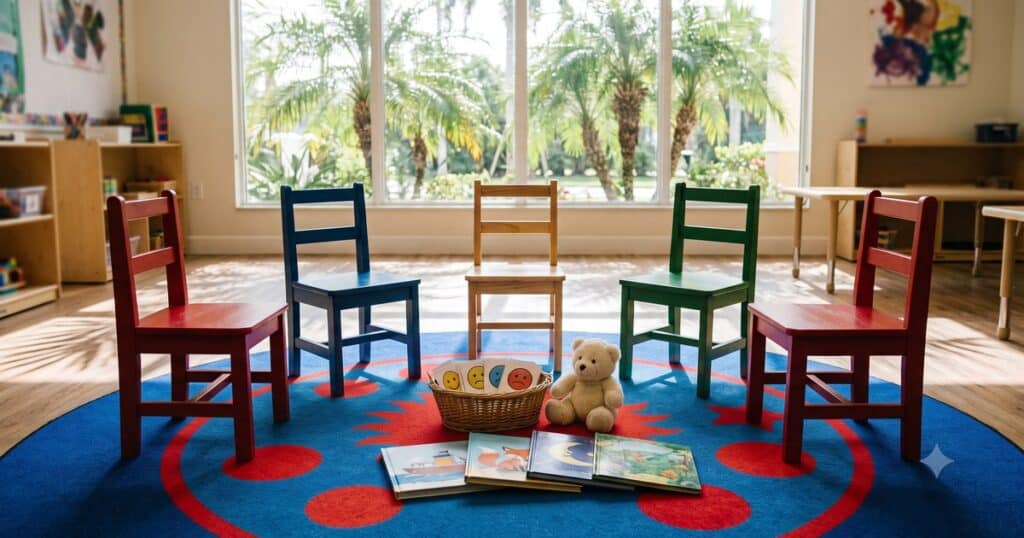
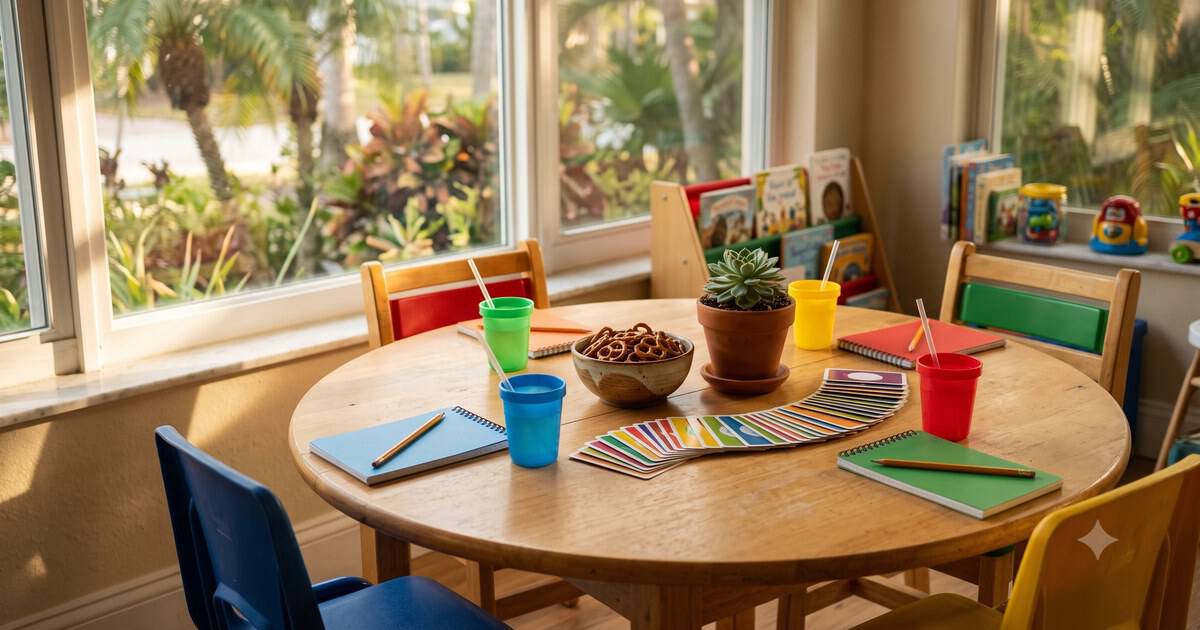
Both programs run for five Friday sessions and cap enrollment at four to six kids per group. The two-age split matters. Mindful Explorers (ages 4 to 7) uses movement, story, art, and short structured play activities calibrated to a younger nervous system and a shorter attention span. Mindful Minds (ages 7 to 12) uses more discussion, more explicit skill teaching, cooperative games, and short reflection exercises calibrated to kids who can start to notice their own patterns and talk about them.
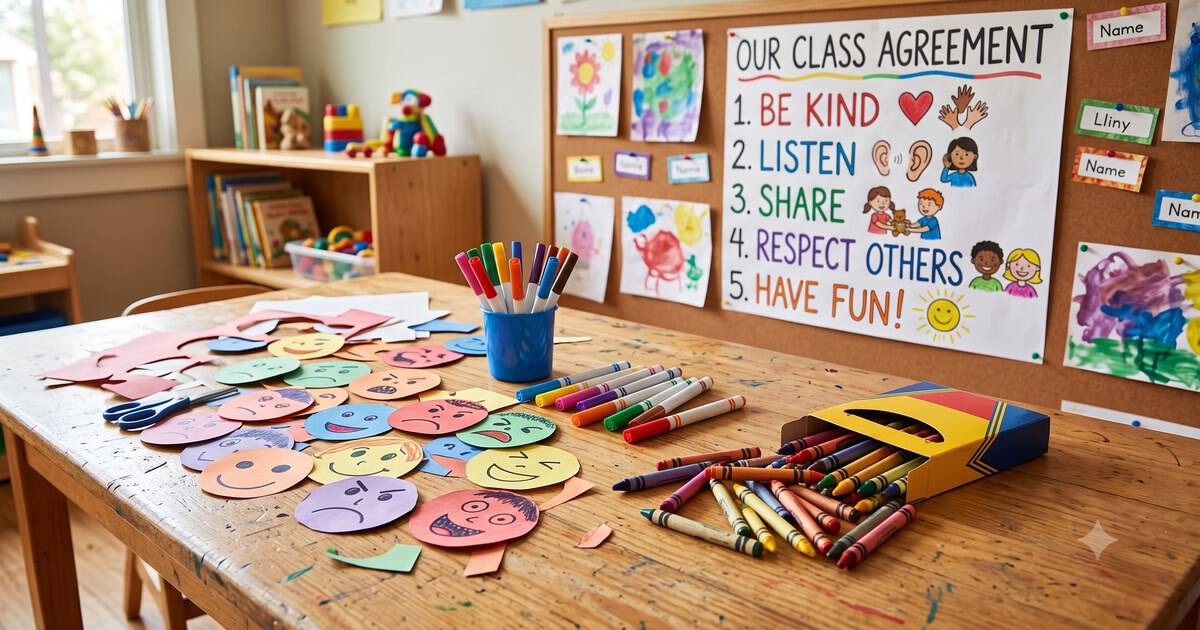
A typical Mindful Explorers session might open with a check-in using a feelings-card sort, move into a movement game that requires waiting and turn-taking, include a short story with a discussion prompt, and close with a calming activity. A typical Mindful Minds session might open with a check-in round, include a short teaching segment on a specific skill (naming a hard emotion, giving a genuine apology, disagreeing without escalating), practice that skill in a structured activity, and close with a brief reflection.
The group is intentionally small because SEL skills are learned by trying them, failing at them, getting real-time coaching, and trying again. That doesn’t happen in a group of twenty. It happens in a group of five where the facilitator can see every kid’s face at once. That structural choice is grounded in what the intervention literature consistently finds: dosage, sequencing, and active practice are the ingredients that make SEL programs work (CASEL Program Guide).
What Parents Can Expect
I want to be concrete about what changes and what doesn’t. What we typically see over a five-session cycle:
Kids get better at naming what they’re feeling in a moment, not an hour later. This shows up at home as “I’m frustrated” instead of a slammed door.
Kids get better at reading the room. Not perfectly. But better. That shows up as noticing when a sibling wants space, or when a co-op friend is having a rough morning.
Kids build a repertoire of specific repair moves. “That came out wrong, let me try again” is a small phrase, but the kids in the group get practice with it in ways that turn it into a reflex over five sessions.
Kids build confidence in a group setting that transfers. This is the one parents report most often: “he seemed more relaxed at co-op the week after group started.”
What I try not to promise. SEL programs aren’t a substitute for individual therapy when a child has a diagnosed condition that needs it. They’re a group learning experience with therapeutic sensibilities, not a group therapy hour. If a child has significant anxiety, ADHD, or a specific learning or emotional condition that a full evaluation identifies, the program can be one useful piece of a larger care plan, not the whole plan.
Parent involvement matters. We check in with parents at the start and midway through, and we send home short between-session prompts so the family can practice the same language at the kitchen table that the kid is practicing in group. SEL that stays in the group room doesn’t transfer. SEL that gets echoed at home does.
Who Runs the Group
Keri Downs, Psy.D. (FL License PY11909) is the program lead for both Mindful Minds and Mindful Explorers. She designs the curriculum for each program, facilitates the sessions, and manages the parent communication throughout the five sessions. Her clinical training and her years of small-group work with kids and families are what make the program model work. The groups meet at The Hub at Skye Ranch in Sarasota; the rest of our practice is based at our Sarasota office.
How to Know if Your Kid Is a Fit
The rough profile of a kid who tends to get the most out of these programs is a child who is developmentally in range, verbal, curious, and either shows some pattern of social friction (bossiness, shutting down, big feelings during group play, difficulty with losing, difficulty with transitions in a group) or is simply looking for structured practice at social confidence. The program is not the right fit for a kid in acute crisis, a kid whose behavior would prevent other kids in the group from getting a good experience, or a kid whose primary need is one-to-one therapy for a specific condition. If we screen a child and they’d be better served by a different path (individual therapy, a full find-your-fit consultation, or a referral out), we’ll say so on the intake call.
For homeschool families across Sarasota, Venice, Lakewood Ranch, and the surrounding areas, the programs are one specific piece of our broader homeschool family services. Our team methodology page explains how we approach assessment and treatment more broadly, including how a small-group experience fits inside a larger care plan when one is warranted.
How to Get Started
If you’d like to talk about whether a Mindful Minds or Mindful Explorers program is a fit for your child, we offer a free 15-minute consultation. You can book a call here or reach our intake at (941) 702-2457. We’ll ask a few questions about your child’s age, current social patterns, and what you’re hoping the program would help with, and we’ll tell you honestly whether the group is the right next step or whether a different piece of our practice would fit better. The programs run in five-session cycles, meeting on Fridays at The Hub at Skye Ranch in Sarasota. Spots are limited by design. If a current program is full, we’ll add you to the interest list for the next cycle.
By Charles R. Davenport, Psy.D., Licensed Psychologist · FL License PY7978 · PSYPACT 15371
Medically reviewed by Charles R. Davenport, Psy.D. on July 9, 2026
Last Updated July 9, 2026
This article was written by Dr. Davenport from his clinical experience and the cited research literature. Read more about how we write our articles.
Dr. Davenport sees patients at our Sarasota office and our Venice office.
Disclaimer: This article is for general educational purposes and is not clinical advice or a substitute for evaluation by a licensed psychologist. If you or your child needs an evaluation or therapy, schedule a free 15-minute consultation.
If in crisis: Contact the 988 Suicide and Crisis Lifeline or your nearest emergency department.
References
- Durlak, J. A., Weissberg, R. P., Dymnicki, A. B., Taylor, R. D., & Schellinger, K. B. (2011). The impact of enhancing students’ social and emotional learning: A meta-analysis of school-based universal interventions. Child Development, 82(1), 405 to 432. PMID 21291449. https://pubmed.ncbi.nlm.nih.gov/21291449/
- Taylor, R. D., Oberle, E., Durlak, J. A., & Weissberg, R. P. (2017). Promoting positive youth development through school-based social and emotional learning interventions: A meta-analysis of follow-up effects. Child Development, 88(4), 1156 to 1171. PMID 28685826. https://pubmed.ncbi.nlm.nih.gov/28685826/
- Collaborative for Academic, Social, and Emotional Learning (CASEL). What Is the CASEL Framework? https://casel.org/fundamentals-of-sel/what-is-the-casel-framework/
- Collaborative for Academic, Social, and Emotional Learning (CASEL). CASEL Program Guide. https://pg.casel.org/
- Centers for Disease Control and Prevention. Children’s Mental Health: Symptoms and Conditions. https://www.cdc.gov/children-mental-health/symptoms-treatment/index.html
- National Institute of Mental Health. Child and Adolescent Mental Health. https://www.nimh.nih.gov/health/topics/child-and-adolescent-mental-health
- American Academy of Child and Adolescent Psychiatry. Practice Parameters and Resource Centers. https://www.aacap.org/AACAP/Resources_for_Primary_Care/Practice_Parameters_and_Resource_Centers/Practice_Parameters.aspx
The Mindful Explorers and Mindful Minds groups described here run as a five-Friday, in-person program at The Hub at Skye Ranch in Sarasota. You can see the dates, session times and enrollment details on the Skye Ranch Homeschool Program page.
Get Professional Help from Licensed Psychologists
Our doctoral-level psychologists in Sarasota and Venice can help with your mental health needs.
Call (941) 702-2457 to schedule a consultation.