

Medically reviewed by Charles R. Davenport, Psy.D. on June 30, 2026
Last Updated June 30, 2026
Executive function is the set of brain processes a kid uses to plan a task, start it, hold the steps in working memory, switch gears when the plan changes, and regulate the frustration that shows up when any of those steps fail. In a classroom, a teacher’s voice and a wall clock do a lot of that scaffolding for the child. At a kitchen table, that scaffolding is gone. The homeschool parent IS the wall clock. That is why executive function breakdown looks different in homeschool kids than it does in their classroom-schooled peers, and it is why so many parents tell our office that their bright child “knows the material” but cannot get a workbook page finished without three reminders, a snack, a meltdown, and a renegotiation. The research is clear that executive function is a strong predictor of academic success across settings, often stronger than IQ (Best, Miller & Naglieri, 2011, PMID 21845021). It is also developmentally normal for the system to be uneven through age 12 or so. The question for most homeschool families is not whether the system is perfect. It is whether the daily breakdown is normal-and-bumpy or whether it is the kind of pattern that warrants an evaluation.
Book a free 15-minute call with Dr. Davenport
What Executive Function Actually Is, in Plain Language
The cleanest synthesis in the literature is from Adele Diamond’s review in the Annual Review of Psychology, which describes three core executive functions: inhibitory control (resisting a distraction or an impulsive answer), working memory (holding information active long enough to use it), and cognitive flexibility (switching strategies when the first one is not working) (Diamond, 2013, PMID 23020641). Built on top of those three are the higher-order skills parents notice most at home: planning, organization, self-monitoring, and task initiation.
A first grader using executive function looks like a kid who can hear “go get your reading book, sit down, and start on page 14” and actually do those three things in order without forgetting the middle one. A fifth grader using executive function looks like a kid who can break “write a one-page report on Florida wetlands” into a brainstorm step, a research step, a draft, and a revision, and who can notice when the draft is going off the rails and reset.
When executive function works, you barely see it. When it breaks down, you see everything.
What Breakdown Looks Like on a Homeschool Day
In my practice I see four signatures of executive function breakdown often enough that they have become the questions I ask first when a parent brings a kid in for evaluation.
Working memory lapses. The kid sits down to do math, gets up to sharpen a pencil, sees the dog, plays with the dog, comes back, and cannot remember what problem he was on. Most parents read this as “not trying.” Often it is actually working memory dropping the thread because the inhibitory-control system never got engaged. The American Academy of Pediatrics’ clinical guidance on ADHD specifically calls out working-memory disruption as a daily-functioning hallmark, not a personality trait (AAP Clinical Practice Guideline for ADHD, 2019).
Task initiation paralysis. The assignment is on the table. The kid knows what to do. He is staring at the wall. Sometimes for forty minutes. This is not laziness. It is the executive-function equivalent of a car that will not turn over. Research on initiation deficits, particularly in kids with attention or learning differences, shows the gap between “intends to start” and “starts” is one of the most reliable markers (Barkley, 2012, Executive Functions: What They Are, How They Work, and Why They Evolved).
Transition meltdowns. Switching from a preferred activity (Lego, a book) to a non-preferred one (handwriting) sets off a disproportionate emotional response. Tears. Door slams. A small body on the floor. The CDC’s child-mental-health pages note that emotional dysregulation tied to executive-function delay is one of the most common parent-reported concerns in early elementary years (CDC: Children’s Mental Health Symptoms).
Planning failures across multi-step tasks. A book report due in two weeks gets started the night before. A science project gets started, abandoned, restarted differently, abandoned again. This pattern is so common in middle-school homeschoolers with undiagnosed ADHD or learning differences that it is often the presenting concern in our intakes.
There is a fifth signature I have come to watch for, and it is the one I used to underweight. Breakdown shows up at the same point in the week, every week. Tuesday afternoons. Thursday mornings after co-op. Friday math. Parents often think of it as a mood, but a recurring pattern at a consistent time slot tells me the system is reaching its load limit on a predictable cycle, which is data, not character.
Why Homeschool Specifically Amplifies This
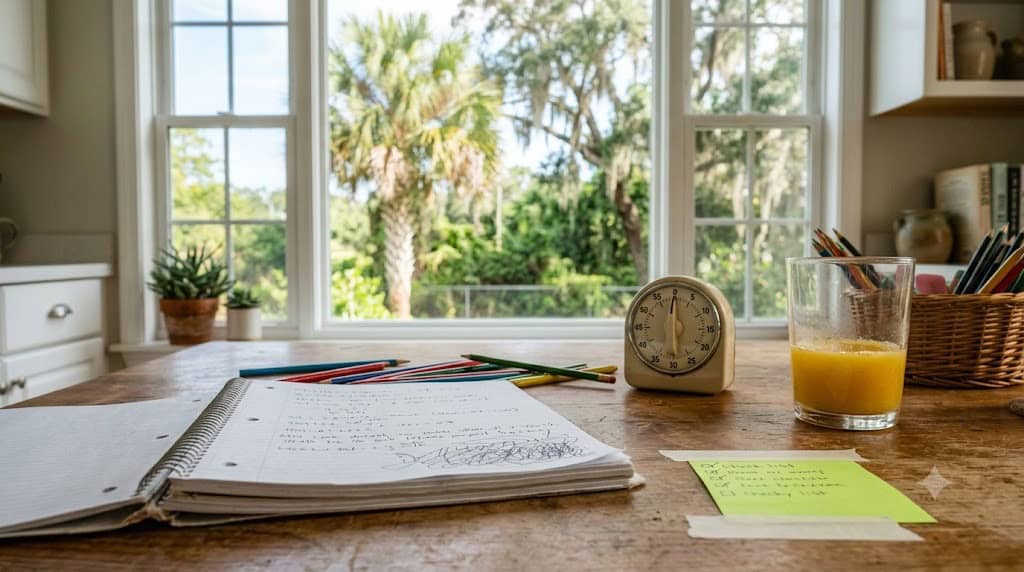
A child who has classroom scaffolding (a bell, a teacher’s eye contact, a row of peers all opening the same book) is getting executive-function support from the environment. The kid does not have to generate every cue from inside their own head. Take that away and what is left is the kid’s own internal scaffolding, which is exactly what executive function IS.
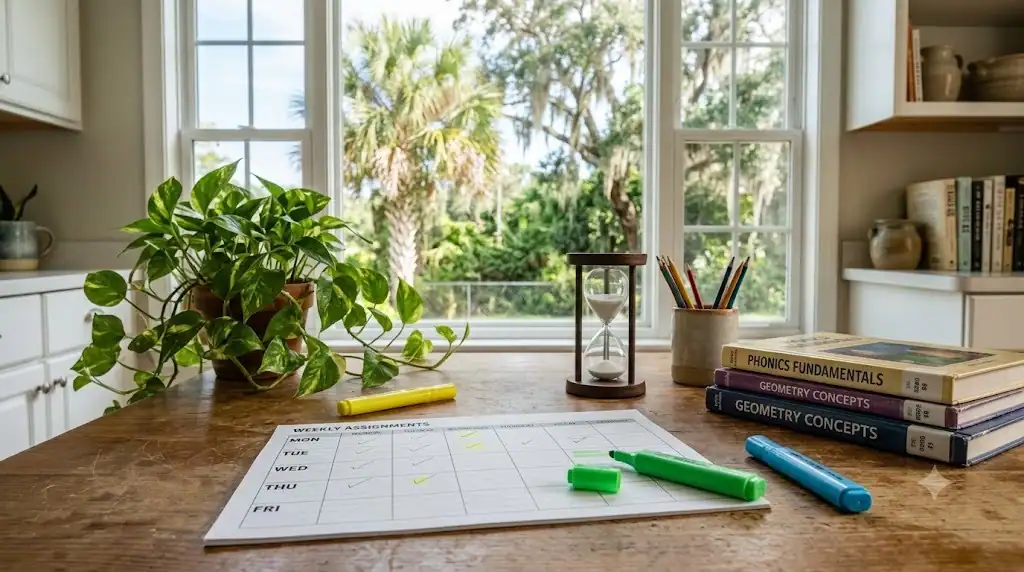
This is not an argument against homeschooling. Two of the most well-organized 13-year-olds I have ever evaluated were homeschooled, and their parents had built explicit external scaffolds (visual schedules, timers, body-doubling routines) that worked beautifully. The point is structural: homeschool reveals executive-function strengths and weaknesses that classroom structure can mask. Some Sarasota and Venice families come to us specifically because they pulled a kid out of a traditional school for unrelated reasons and discovered, three months in, that the underlying executive-function profile was the thing the classroom was actually compensating for.
The research literature on autonomy-supportive learning environments is genuinely mixed on whether less external structure is better or worse for executive-function development. The honest answer is “it depends on the kid.” For a kid with strong baseline EF, less structure can build skill. For a kid with delayed or atypical EF, less structure can expose the delay early, which is often a gift in disguise because it accelerates identification and intervention. The National Institute of Mental Health’s ADHD resources lay out the developmental trajectory and treatment options that follow if attention or executive-function differences are suspected.
What the Research Says About Identifying the Pattern
The AACAP practice parameters for ADHD assessment emphasize that executive-function complaints in isolation are not diagnostic, but that they ARE one of the most reliable parent-reported entry points into a full neurodevelopmental workup (AACAP Practice Parameter for ADHD, 2007, updated guidance). What this means practically for a homeschool family: a kid who is melting down on transitions AND missing multi-step directions AND forgetting what he was doing mid-task is showing a cluster, not a quirk. Clusters warrant evaluation. Single quirks usually do not.
A comprehensive evaluation looks at cognitive ability, achievement, attention, executive function, and social-emotional functioning all at once, because executive-function complaints can show up in ADHD, in specific learning disorders (especially reading and written-expression disorders), in anxiety, in autism spectrum profiles, and in twice-exceptional (2E) gifted-and-struggling profiles where the strengths actually mask the weaknesses. Sorting that out is what psychological testing and a psychoeducational consultation are designed to do.
When Parents Should Consider an Evaluation
A reasonable rule of thumb. If the executive-function pattern at home meets three of the following, it is worth a conversation:
- The pattern shows up across multiple subjects, not just the one your kid dislikes.
- The intensity is disproportionate to the task (a 30-minute meltdown over a 10-minute worksheet).
- The pattern has been present for at least three to six months.
- It is interfering with the family relationship, not just the schoolwork.
- Your gut says something is off.
I want to be honest about that last one. Parents who homeschool know their kid in a way no clinician will ever match. When the parent’s gut says something is off, even if they cannot articulate exactly what, it is usually worth a conversation. That conversation does not have to start with a full evaluation. It can start with a 15-minute call.
For Florida families, the FES-UA scholarship and the Personalized Education Program (PEP) administered through Step Up for Students cover psychoeducational evaluation at our practice in full when the family qualifies, which removes the cost barrier for most homeschool families who want to know.
How to Get Started
If you are reading this because your kid’s homeschool day keeps falling apart and you cannot tell whether it is executive function, attention, a learning difference, or just a hard season, we offer a free 15-minute call to help you sort through what would actually be useful next. You can book a call here or reach our intake at (941) 702-2457. Our homeschool family services page describes how we work with homeschool kids specifically, and our team methodology page explains how we approach assessment.
By Charles R. Davenport, Psy.D., Licensed Psychologist · FL License PY7978 · PSYPACT 15371
Medically reviewed by Charles R. Davenport, Psy.D. on June 30, 2026
Last Updated June 30, 2026
This article was written by Dr. Davenport from his clinical experience and the cited research literature. Read more about how we write our articles.
Dr. Davenport sees patients at our Sarasota office and our Venice office.
Disclaimer: This article is for general educational purposes and is not clinical advice or a substitute for evaluation by a licensed psychologist. If you or your child needs an evaluation or therapy, schedule a free 15-minute consultation.
If in crisis: Contact the 988 Suicide and Crisis Lifeline or your nearest emergency department.
References
- Best, J. R., Miller, P. H., & Naglieri, J. A. (2011). Relations between executive function and academic achievement from ages 5 to 17 in a large, representative national sample. Learning and Individual Differences, 21(4), 327 to 336. PMID 21845021. https://pubmed.ncbi.nlm.nih.gov/21845021/
- Diamond, A. (2013). Executive functions. Annual Review of Psychology, 64, 135 to 168. PMID 23020641. https://pubmed.ncbi.nlm.nih.gov/23020641/
- American Academy of Pediatrics, Subcommittee on Children and Adolescents with ADHD. (2019). Clinical Practice Guideline for the Diagnosis, Evaluation, and Treatment of Attention-Deficit/Hyperactivity Disorder in Children and Adolescents. Pediatrics, 144(4). https://publications.aap.org/pediatrics/article/144/4/e20192528/81590/Clinical-Practice-Guideline-for-the-Diagnosis”>AAP Clinical Practice Guideline for ADHD, 2019
- Barkley, R. A. (2012). Executive Functions: What They Are, How They Work, and Why They Evolved. Guilford Press. https://www.guilford.com/books/Executive-Functions/Russell-Barkley/9781462505357
- Centers for Disease Control and Prevention. Children’s Mental Health: Symptoms and Conditions. https://www.cdc.gov/children-mental-health/symptoms-treatment/index.html
- American Academy of Child and Adolescent Psychiatry. Practice Parameters and Resource Centers (ADHD parameter). https://www.aacap.org/AACAP/Resources_for_Primary_Care/Practice_Parameters_and_Resource_Centers/Practice_Parameters.aspx
- National Institute of Mental Health. Attention-Deficit/Hyperactivity Disorder (ADHD). https://www.nimh.nih.gov/health/topics/attention-deficit-hyperactivity-disorder-adhd
- Florida Department of Education. Family Empowerment Scholarship for Students with Unique Abilities (FES-UA). https://www.fldoe.org/schools/school-choice/k-12-scholarship-programs/fes/
Get Professional Help from Licensed Psychologists
Our doctoral-level psychologists in Sarasota and Venice can help with your mental health needs.
Call (941) 702-2457 to schedule a consultation.