
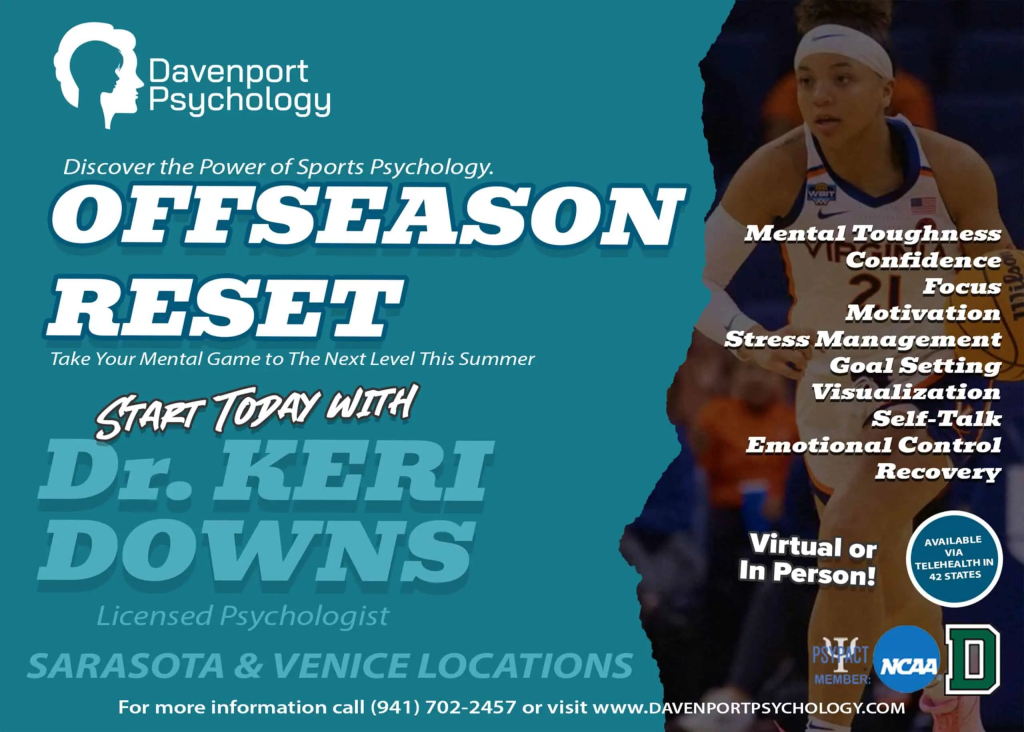
Women’s basketball has entered a new era of visibility, intensity, and competition. The growth of the WNBA, record-breaking NCAA tournament viewership, and increased investment in women’s sports have raised both the stakes and the psychological demands on female basketball players at every level. Yet mental training remains one of the most underutilized advantages available to these athletes — particularly during the off-season, when there is time and space to build the cognitive and emotional skills that separate good players from great ones.
Research published in the Journal of Applied Sport Psychology has consistently shown that psychological skills training — including goal setting, imagery, self-talk regulation, and arousal control — produces measurable improvements in athletic performance across competitive levels (Vealey, 2007). For women’s basketball players specifically, the off-season represents an optimal window to develop these skills without the pressure of upcoming games or the fatigue of a full competition schedule.
Why the Off-Season Matters for Mental Performance
During the competitive season, athletes operate in a state of continuous physical and psychological demand. Games, travel, film study, and practice leave little bandwidth for the kind of reflective, skill-building mental work that produces lasting change. The off-season removes that pressure and creates conditions where athletes can examine their psychological patterns honestly — without the immediate consequence of a bad game or a lost playoff spot.
A study in the International Journal of Sports Science and Coaching found that athletes who engaged in structured mental skills training during the off-season showed greater improvements in self-confidence, concentration, and emotional regulation at the start of the following season compared to athletes who focused exclusively on physical conditioning (Holliday et al., 2008). The off-season is not downtime — it is development time, and the mental component deserves the same intentional investment as strength training or skill work.
Core Mental Skills for Women’s Basketball
Confidence and Self-Efficacy
Confidence in basketball is not a personality trait — it is a skill that can be systematically built. Albert Bandura’s self-efficacy theory identifies four primary sources of confidence: mastery experiences (past successes), vicarious learning (watching others succeed), verbal persuasion (coaching feedback), and physiological states (how the body feels during performance) (Bandura, 1997). A sport psychologist works with athletes to strengthen each of these sources deliberately, rather than leaving confidence to chance.
For women’s basketball players, confidence challenges often carry a gendered dimension. Research from the Women in Sport and Physical Activity Journal has documented that female athletes are more likely than male athletes to experience imposter-type cognitions — the persistent belief that their success is undeserved or that they will be “found out” as less talented than others perceive them to be (Howells & Fletcher, 2015). These cognitions can erode performance even in highly skilled players, and they rarely resolve without targeted intervention.
Focus and Attentional Control
Basketball is a sport that demands rapid attentional shifts — from scanning the floor for open teammates to tracking a defender’s positioning to reading the shot clock. The ability to direct and redirect attention under pressure is what sport psychologists call attentional control, and it is trainable.
Mindfulness-based interventions have shown particular promise in this area. A meta-analysis published in Psychology of Sport and Exercise found that mindfulness training improved attentional focus and reduced performance-irrelevant thoughts (such as worrying about the score or replaying a previous mistake) in competitive athletes (Bühlmayer et al., 2017). For basketball players, this translates to staying present on each possession rather than mentally carrying the last turnover into the next play.
Emotional Regulation Under Pressure
A hostile road crowd, a questionable call, a teammate’s mistake at a critical moment — basketball constantly generates situations that trigger frustration, anger, or anxiety. Players who can regulate these emotions quickly maintain their decision-making quality. Players who cannot will make impulsive fouls, force contested shots, or withdraw from aggressive play.
Acceptance and commitment therapy (ACT) offers a framework for emotional regulation that is especially well-suited to athletes. Rather than trying to suppress or eliminate difficult emotions — which research shows is often counterproductive — ACT teaches athletes to notice the emotion, accept its presence, and redirect attention to the task at hand (Association for Contextual Behavioral Science). A player who feels anxious during a free throw can learn to shoot with the anxiety present, rather than waiting for it to disappear.
Visualization and Mental Rehearsal
Visualization — also called mental imagery or mental rehearsal — involves creating a vivid, multisensory internal experience of successfully executing a skill or navigating a game situation. The evidence base for visualization in sport is robust. A review published in the Journal of Sports Sciences confirmed that mental practice, when combined with physical practice, produces performance improvements beyond physical practice alone (Driskell et al., 1994).
For basketball players, effective visualization includes not just successful outcomes (the ball going through the hoop) but the process elements that produce those outcomes: footwork, body positioning, hand placement, breathing rhythm, and the feel of the ball at the release point. Off-season visualization sessions allow athletes to mentally rehearse game situations — late-clock isolation plays, defensive rotations, inbound plays against a press — in a low-pressure environment where errors carry no real consequences.
The Gender-Specific Dimension
Women’s basketball players face psychological challenges that their male counterparts often do not. These include navigating media coverage that frequently foregrounds appearance over performance, managing the emotional labor of being expected to be both competitive and “likable,” and contending with persistent pay and resource disparities that signal institutional undervaluation. The NCAA’s own external review following the 2021 tournament equity concerns acknowledged systemic differences in how women’s and men’s basketball programs are resourced and promoted (NCAA Gender Equity Review, 2021).
A sport psychologist who understands these dynamics can help female athletes develop strategies for coping with structural stressors without internalizing them as personal failures. This is not about ignoring inequity — it is about building the psychological resilience to perform at a high level within an imperfect system while simultaneously advocating for change.
What Off-Season Mental Training Looks Like in Practice
Working with a sport psychologist during the off-season typically involves an initial assessment of the athlete’s psychological strengths and areas for development, followed by structured sessions targeting specific mental skills. A common off-season program might include sessions on performance profiling and goal setting, followed by work on pre-performance routines and self-talk restructuring. Arousal regulation and focus training come next, building toward imagery-based competition simulation as the season approaches.
At Davenport Psychology, our doctoral-level psychologists provide sports and performance psychology services for athletes at all competitive levels — from youth travel basketball to collegiate and professional athletes. Sessions are available at our Sarasota and Venice offices, as well as via telehealth for athletes throughout Florida and 40+ PSYPACT states.
Frequently Asked Questions
At what competitive level should a basketball player start working with a sport psychologist?
There is no minimum competitive level. Mental skills are trainable at any age and any level of play. High school athletes who develop psychological skills early often carry those advantages into college and beyond. That said, athletes who are experiencing performance anxiety, burnout, or declining motivation at any level can benefit from professional support.
How is sport psychology different from regular therapy?
Sport psychology focuses specifically on the mental factors that affect athletic performance: confidence, focus, arousal regulation, imagery, goal setting, and competitive mindset. A sport psychologist who also holds a clinical license — as our doctoral-level psychologists do — can additionally address clinical concerns like anxiety disorders, depression, or identity issues that may be affecting both the athlete’s performance and their overall well-being.
Can mental training actually improve shooting percentage or game statistics?
Yes. The research literature consistently demonstrates that psychological skills training — particularly visualization and self-talk restructuring — produces statistically significant improvements in motor performance, including shooting accuracy. Mental training does not replace physical practice, but it meaningfully enhances it.
Do you work with teams or only individual athletes?
Both. Individual sessions allow for personalized assessment and targeted skill development. Team-based workshops can address group dynamics, communication, leadership, and shared performance goals. The optimal approach depends on the team’s needs and the athletes’ individual situations.
How many sessions does it take to see results?
Most athletes begin noticing improvements in confidence and focus within 4-6 sessions. More complex issues — such as performance anxiety rooted in perfectionism or burnout following years of overtraining — may require a longer engagement. Your psychologist will develop a structured plan based on the initial assessment and adjust it as you progress.
References
Association for Contextual Behavioral Science. (2024). ACT (Acceptance and Commitment Therapy). https://contextualscience.org/act
Bandura, A. (1997). Self-efficacy: The exercise of control. W.H. Freeman.
Bühlmayer, L., Birrer, D., Röthlin, P., Faude, O., & Donath, L. (2017). Effects of mindfulness practice on performance-relevant parameters and performance outcomes in sports. Psychology of Sport and Exercise, 33, 1-13.
Driskell, J. E., Copper, C., & Moran, A. (1994). Does mental practice enhance performance? Journal of Applied Psychology, 79(4), 481-492.
Holliday, B., Burton, D., Sun, G., Hammermeister, J., Naylor, S., & Freigang, D. (2008). Building the better mental training mousetrap. The Sport Psychologist, 22(2), 153-174.
Howells, K., & Fletcher, D. (2015). Sink or swim: Adversity- and growth-related experiences in Olympic swimming champions. Psychology of Sport and Exercise, 16, 37-48.
NCAA. (2021). NCAA gender equity review: Phase 1. https://ncaagenderequityreview.com/
Vealey, R. S. (2007). Mental skills training in sport. In G. Tenenbaum & R. C. Eklund (Eds.), Handbook of sport psychology (3rd ed., pp. 287-309). Wiley.
Learn more about our Sarasota office, our Venice office, and the full range of psychology services available at Davenport Psychology.
Get Professional Help from Licensed Psychologists
Our doctoral-level psychologists in Sarasota and Venice can help with your mental health needs.
Call (941) 702-2457 to schedule a consultation.